
97% Fewer Defects: How an Arizona Plastics Manufacturer Eliminated Regrind Fines With a Second-Stage Cyclone
Your defects might not be a process problem
You’ve adjusted the tooling. You’ve checked melt temp, drying cycles, screw RPM. Maintenance has been through the press twice. The defects keep showing up — holes, thin spots, the occasional chunk you can’t explain — and your scrap pile is telling a story your process data isn’t.
Before you change another setting, look at what’s coming out of your regrind.
Fine dust in regrind is one of the most under-diagnosed sources of molding defects in the industry. It doesn’t show up on a process chart. It doesn’t trip an alarm. It just quietly contaminates your melt and shows up as a defect on the back end. And if your operation is grinding and reusing material, there’s a good chance it’s happening to you too.
Here’s how a small Arizona manufacturer found theirs — and what it took to fix it.
The operation: 5-gallon polycarbonate bottles, made in the Southwest
The customer is a small Arizona plastics manufacturer. They make refillable polycarbonate 5-gallon water cooler bottles — the kind you’ve seen on a thousand office water dispensers, supplied by the major national water-delivery brands.
It’s a tight, technical operation. Polycarbonate is unforgiving. It needs clean, dry, consistent material to mold a defect-free bottle, and at this scale, even small amounts of contamination show up immediately in the finished part. Being able to walk their floor on short notice is part of why having a dust collection partner here in the Southwest mattered for a fix this precise.
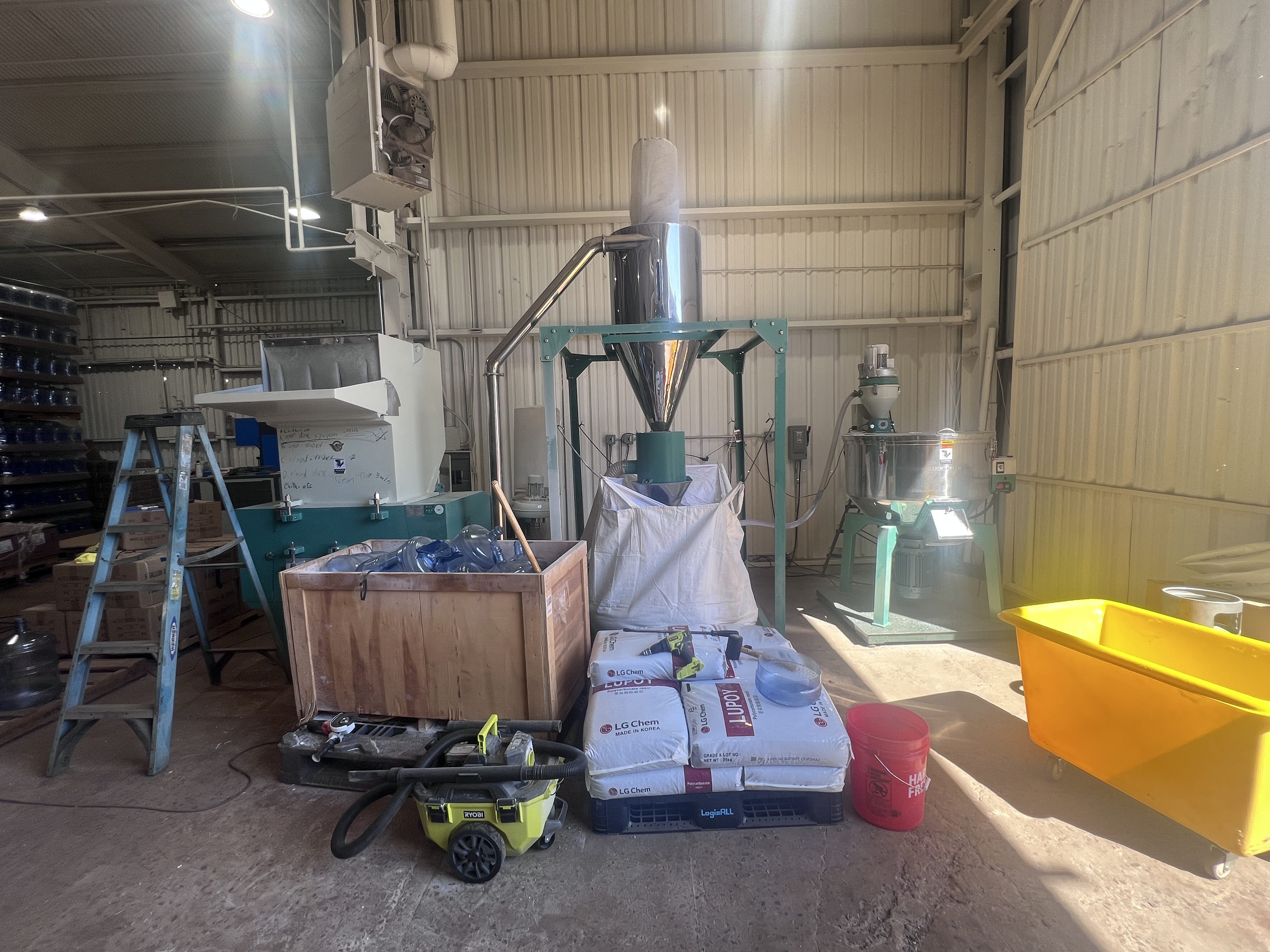
They run their own granulator on returned and rejected bottles, feeding the regrind back into their mix. That’s standard practice — and it’s also where their problem started.
The defects they were seeing
The defects were product-killers, not cosmetic ones:
- Holes — small voids straight through the bottle wall
- Thin spots — sections where wall thickness was below spec, weakening the part
- Chunks — visible inclusions in the polycarbonate, sometimes large enough to see across a room
Every one of these meant a rejected bottle. For a small operation supplying brands that won’t tolerate quality misses, the scrap rate was unsustainable and the customer relationships were getting tense.
They’d already done the hard part: finding the cause
By the time they called us, they’d done what good operators always do — they’d traced the problem themselves. Process settings were dialed in. The dryer was working. The granulator was producing regrind at the right particle size.
The issue was the regrind itself. It carried too much fine dust.
Polycarbonate dust melts unevenly compared to properly granulated regrind. When it goes into the mix, it creates inconsistent melt flow — and inconsistent melt flow shows up as holes, thin spots, and chunks in the finished part. They knew the cause. They needed the fix.
Why their existing cyclone wasn’t enough
Here’s the part most plastics operations get wrong: having a cyclone is not the same as having a cyclone sized for fines.
The customer already had a large stainless separator cyclone running in line with their granulator. It was doing its job — pulling out chips and flakes, dropping clean-looking regrind into the output bin. From the outside, the system looked like it was working.
It wasn’t, at the level that mattered.
Cyclone separation efficiency is a function of inlet velocity. The faster the air spins inside the cyclone, the smaller the particles you can fling out of the air stream. Their primary cyclone was sized for separating chip-and-flake sized material — adequate for the big stuff, but the velocity was too low to spin out fine particulate. The fines stayed entrained in the air, dropped down into the output bin with the regrind, and ended up back in the mix.
A bigger cyclone wasn’t the answer. A faster cyclone — running the right velocity for the particle size they needed to capture — was.
What we installed
We added an RP1 cyclone running at 3,500 FPM inlet velocity, plumbed directly to the output of their existing separator. The RP1 sits downstream of the primary cyclone, capturing the fine particulate that escapes the larger unit before it can drop into the regrind bin.
The airflow path now looks like this:
Granulator
    ↓
Primary Cyclone Separator  →  Chips/flakes  →  Regrind output
    ↓
Air stream with fines
    ↓
RP1 Cyclone (3,500 FPM)  →  Fines captured  →  Filter sock
    ↓
Clean exhaust air
Total project cost: $15,000.
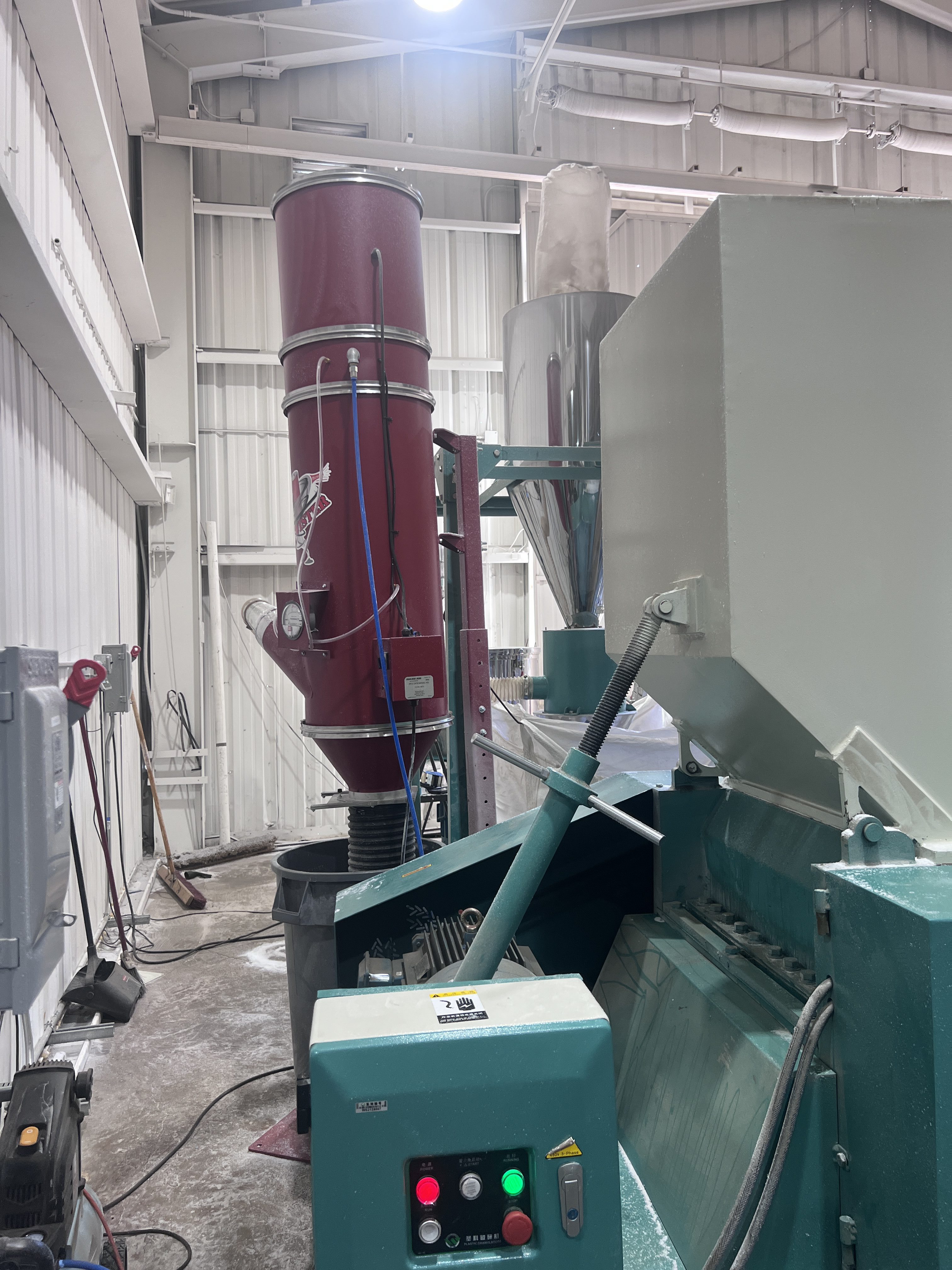
The 3,500 FPM is the part of the spec that matters most. That’s the velocity needed to spin out the particle size range that was contaminating their regrind. Lower velocity, the fines stay airborne. Higher velocity, you start carrying chip-size material out the top with the air. 3,500 was the right number for their material, their volume, and their geometry.
The result: 97% defect reduction, virtually dustless regrind
The system has been running for almost a year.
- Defects are down 97%
- Regrind comes out of the bin virtually dustless
- Scrap rate is back to a level the operation can absorb
- Customer relationships with the major brands are no longer at risk
This is what a $15,000 install looks like when the diagnosis is right and the engineering matches the problem. For a plastics operation running production volumes, the system paid for itself many times over in the first quarter alone — purely in scrap reduction, before counting any of the soft costs of late shipments or customer complaints.
Could this work for your operation?
If you’re running a granulator and reusing regrind, you should be asking three questions:
- What particle size is your existing cyclone designed to capture? If you don’t know, that’s the first answer to find. The cut-point — the smallest particle the cyclone reliably removes — is the number that determines whether fines are getting into your regrind.
- What does your regrind look like under a magnifying glass? Visible dust, a hazy coating, or a layer of fines at the bottom of the bin are all signs the cyclone isn’t doing the job at the small-particle end.
- What defects are you chasing? Holes, thin spots, voids, inclusions, color streaks, surface defects on clear or light-colored parts — fines in regrind can cause every one of these.
If two or more of those questions point to fines, a second-stage cyclone is one of the lowest-cost, highest-impact fixes available to a plastics operation.
When this approach is NOT right for you
You’ll see plenty of equipment vendors tell you a cyclone solves every dust problem. We won’t.
A second-stage cyclone is the right fix when:
- You’re running a granulator and reusing regrind
- Fines are the diagnosed cause of your defect pattern
- Your existing cyclone is sized correctly for chip/flake separation but undersized for fines
- Your dust is non-combustible or has been evaluated under NFPA 660 and cleared for cyclone capture
A cyclone is not the right fix when:
- Your defects are caused by moisture, contamination from outside sources, or process variables — diagnose first
- Your existing cyclone is undersized for chip separation as well as fines (you need a different solution at the primary)
- You’re processing combustible plastic dusts (some grades of ABS, nylon, certain filled compounds) where deflagration risk requires a properly engineered explosion-protected collector — a standard cyclone is not appropriate
- Your operation needs HEPA-grade air return for medical, food-contact, or cleanroom requirements — cyclones don’t capture sub-micron particulate; you need HEPA filtration downstream
If any of these describe your operation, the right next step is a free assessment — not a cyclone quote.
What this looks like for your operation
Get a free regrind fines assessment. We’ll come on-site, look at your granulator and existing collection setup, take a sample of your regrind, and tell you whether fines are the problem and what it would take to fix.
Every system we engineer is backed by our pass-or-free guarantee — your system passes inspection and performs to spec, or we fix it at no charge. Installation is handled by an ICAP Certified crew.
Frequently Asked Questions
What size particles does an RP1 cyclone capture at 3,500 FPM?
A cyclone running at 3,500 FPM reliably captures particles down to roughly the 5–10 micron range, depending on dust density and geometry. That’s the size range where most plastic regrind fines live — too small for a chip-flake cyclone to spin out, large enough that a properly sized cyclone catches them efficiently. For sub-micron particulate, you need a downstream filter (HEPA or cartridge) — a cyclone alone won’t capture that.
Can you retrofit a second-stage cyclone onto an existing system?
Yes — that’s exactly what we did in this case. The RP1 was plumbed to the output of the customer’s existing separator without modifying their primary cyclone or granulator. Most retrofits take 1–2 days of install time once the equipment is on site. The bigger question is always whether your existing system is sized correctly for the primary separation; if it isn’t, retrofitting fines capture downstream won’t solve the underlying problem.
Is polycarbonate dust combustible?
Polycarbonate dust has a measurable KSt value but is generally considered low-to-moderate explosibility compared to wood, metal, or certain organic dusts. That said, every operation handling combustible dust is required to have a dust hazard analysis (DHA) under NFPA 660, regardless of how mild the dust is. The DHA determines whether explosion protection is required for your specific volumes, concentrations, and equipment. Don’t assume — get the analysis.
How much does a project like this cost?
This particular install was $15,000 turnkey. Pricing varies with the size of the cyclone, ductwork run, electrical work, and whether explosion protection is required. For a full breakdown of what drives dust collection system pricing, see our 2026 dust collection cost guide.
How do I know if my regrind has too many fines?
The simplest test: take a clean glass jar, fill it halfway with fresh regrind, seal it, and shake. Let it settle for 30 seconds. If you see a haze of fine particulate suspended in the air space, or a noticeable dust layer settling on the inside of the jar, you have a fines problem. The more visible the haze, the bigger the problem. Anyone running a granulator should be doing this test monthly.
Will adding a second cyclone affect my existing equipment warranty?
In most cases, no — a downstream cyclone doesn’t modify the primary equipment, it captures what comes out of it. But warranty terms vary by manufacturer, and we always recommend confirming with your equipment vendor before any modification. If you’re concerned, we can review your current setup and warranty language during the assessment.
What about my granulator — should I be doing anything different there?
Granulator screen size and blade condition both affect how many fines you generate in the first place. Worn blades grind material instead of cutting it cleanly, which produces more dust. Screen size determines particle size distribution. If your operation is producing excessive fines, the granulator is worth a review even after you fix the downstream capture — generating less dust upfront is always cheaper than catching it later.
Related reading
- Architect’s Guide to Specifying Industrial Dust Collection Systems — how the right spec gets locked in before equipment is ever ordered
- Why a Local Dust Collection Partner Matters in the Southwest — what on-site access changes when the diagnosis has to be exact
- Baghouse vs. Cartridge Dust Collectors: Which Do You Need? — matching collector type to your dust and particle size