
Three Brands · Honest Comparison · IAP Ships From Factory Stock
Source Capture Fume Arms: Which One Fits Your Shop?
Welding · Powder applications · Food & pharma · Lab environments · 3″–8″ diameters · 5’–14′ reach · Hanging, standing, telescopic & stainless steel. Delivered prices typically $1,200–$3,800.
DustHog and SmogHog equipment
DustHog and SmogHog source capture equipment we supply
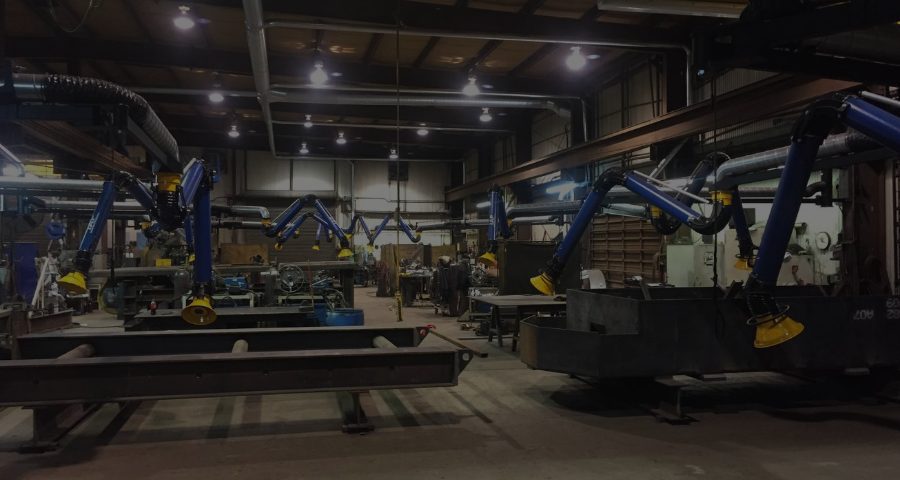
Capture at the arc beats capture at the ceiling every time, as long as the arm actually reaches the work. These are the DustHog and SmogHog source capture units we supply.
DustHog XA and TSA Extraction Arms
Eleven part numbers across the XA, TSA and V-750 arms for capture at the weld.
See DustHog XA specsDustHog SCB Ceiling Mounted Source Capture
Three builds to 2,000 CFM with two 8 inch arms off an overhead unit.
See DustHog SCB specsDustHog PNP Plug-N-Play Collector
Arrives wired and ready to run. DustHog rates the PNP for non combustible dry dust.
See DustHog PNP specsSmogHog PCN Portable Fume and Mist Collector
Portable capture for fume and mist where the job changes.
See SmogHog PCN specsDustHog VF Fixed Ducted Collector
A ducted cartridge unit for a fixed process that runs every shift.
See DustHog VF specsDustHog Dust Collectors
The full DustHog line, from portable benches to 102,000 CFM modular cartridge.
See the DustHog lineNot sure which of these fits your floor? Tell us what your process puts into the air and we will size it against your actual conditions.
Get a free system reviewSource capture fume arms are the most effective and most affordable way to keep welding fumes, powder particulate, and lab contaminants out of your workers’ breathing zone. Position the arm near the source, and the contaminant gets pulled away before anyone inhales it. No ductwork redesign, no ambient system, no waiting months for design.
You’ve got four brands to choose from through us: DustHog, IAP Air Products, MicroAir Plymovent, so the right arm gets matched to your application, budget, and timeline. Most shops don’t need the premium option. Here’s a straight comparison so you can decide for yourself. DustHog XA and TSA arms are in the shop section at the top of this page, and they ship in 8 to 10 weeks.
Why this matters for compliance: OSHA PELs for welding fumes are routinely exceeded within minutes of arc-on at an uncontrolled station. Hexavalent chromium (Cr VI) has a PEL of 5 µg/m³. Manganese has an ACGIH TLV of 0.02 mg/m³. For powder applications like pharmaceutical, food supplement, and nutraceutical manufacturing, source capture is also the primary method for containing fine particulate at the point of generation before it becomes a cross-contamination or explosion risk. Source capture is the OSHA-recognized engineering control for all of these.
For NFPA 660 compliance on combustible dust applications, see our NFPA 660 checklist.
Need help sizing? Diameter matters more than most people think. We size arms on your actual CFM requirement and the capture velocity you need at the hood, not guesswork. For a full breakdown of system costs, see our 2026 cost guide.
Head-to-Head
Before the specs: 75 seconds on where the hood actually has to sit (6 to 10 inches from the arc), what a portable really costs in filters, and when a dual-arm unit is the better buy.
Side-by-Side Specs Comparison
| Feature | IAP Air Products ★ | MicroAir | Plymovent |
|---|---|---|---|
| Availability | 2,000+ in IAP factory stock: ships in 2 to 3 business days | Distributor network: lead times vary | Made to order: longer lead times |
| Diameter Options | 3″, 4″, 6″, 8″ | 4″, 6″, 8″ | 3″ (75mm), 6.3″ (160mm), 7.9″ (200mm) |
| Length Options | 5′ to 14′ (extensions to 35′) | 5′, 7′, 9′, 12′ | 3.3′ to 13′ (extensions to 26′) |
| Tube Material | 26-ga galvanized steel (powder-coated blue), 304 stainless option | Externally supported tube | Aluminum tube |
| Hood Material | Aluminum (powder-coated yellow), 304 stainless option | Included with pre-wired controls | Varies by model (RotaHood option) |
| Positioning | External aluminum joints, spring shock | Gas shock system | BalanceWheel system (select models) |
| CFM Range | 150–1,400+ CFM | 300–1,000 CFM | 353–1,177 CFM |
| Special Features | Shut-off damper, grab handle, light kit, spark shield, wall mount kit | Pre-wired hood controls, light kit option | ATEX versions, FlowGuard sensor, RotaHood |
| Best For | Most shops, schools, and immediate needs | Mid-range welding ops | Heavy industrial, ATEX, frequent repositioning |
Brand 1 · Our Pick for Most Shops
IAP Air Products
Largest stocking fume arm supplier in the U.S., with 2,000+ arms ready to ship from Tennessee. Four diameter options, galvanized steel construction, and the best price-to-performance in the industry. $1,200–$3,800, with freight added at checkout.
Hanging Fume Arms
Wall, column, or I-beam mount
→ 3″, 4″, 6″, 8″ diameters
→ 5′ to 14′ reach
→ Galvanized steel, powder-coated blue
→ Spring shock positioning
→ Shut-off damper & grab handle
→ Wall mount kit included · Ships in 2 to 3 business days
Standing Fume Arms
Floor-mounted, no wall needed
→ 3″, 4″, 6″, 8″ diameters
→ 5′ to 14′ reach
→ Same construction as hanging
→ Floor pedestal base
→ No wall or column required
→ Ideal where overhead isn’t an option
Stainless & Telescopic
Specialty models for specific needs
→ 304 stainless steel w/ FDA-approved hoses
→ Food processing, pharma, clean rooms
→ Telescopic: in/out trumpet movement
→ 4″, 6″, 8″ · 4’–7′ reach
→ Space-saving for tight areas
→ Popular with schools & labs
✓ Pros
→ 2,000+ arms in IAP factory stock: ships in 2 to 3 business days
→ Four diameter options (3″, 4″, 6″, 8″)
→ Best price-to-performance ratio
→ Galvanized steel handles shop abuse
→ 304 stainless available for food/pharma
→ 8–12 year lifespan in real shops
✗ Cons
→ Heavier than aluminum arms
→ Positioning not as effortless as BalanceWheel
Brand 2 · Solid Mid-Range Choice
MicroAir
Gas shock positioning, pre-wired hood controls, and clean airflow design. A solid step-up for shops that want smoother arm movement and are willing to wait for delivery.
Source Capture Arms
Hanging & standing models
→ 4″, 6″, 8″ diameters
→ 5′, 7′, 9′, 12′ lengths
→ Gas shock positioning system
→ Pre-wired hood controls
→ Light kit option available
→ 300–1,000 CFM range
✓ Pros
What MicroAir does well
→ Gas shock makes repositioning smooth
→ Pre-wired controls save install time
→ Clean internal airflow design
→ Good mid-range value
→ Externally supported tube holds position
✗ Cons
Where they fall short
→ Fewer diameter options (no 3″)
→ Longer lead times than IAP
→ Less spec transparency on website
→ Distributor network can add time
Brand 3 · Premium Option
Plymovent
50+ years of European engineering. BalanceWheel effortless positioning, ATEX-certified models for explosive environments, and FlowGuard airflow monitoring. Best for heavy industrial or specialized compliance requirements.
UltraFlex
Standard extraction arm
→ 6.3″ (160mm) or 7.9″ (200mm)
→ 3.3′ to 13′ reach
→ Aluminum tube: light & durable
→ Low pressure loss design
→ RotaHood option
→ 353–941 CFM
MultiSmart
BalanceWheel positioning
→ 6.3″ (160mm) or 7.9″ (200mm)
→ BalanceWheel effortless positioning
→ FlowGuard airflow sensor available
→ Extensions to 26′
→ ATEX-certified options
→ 765–1,177 CFM
MiniMan & Specialty
Compact & ATEX models
→ 3″ (75mm) compact arm
→ Light soldering & lab work
→ ATEX-certified versions available
→ Stainless steel options
→ Light kit & spark shield accessories
→ Made to order
✓ Pros
→ Effortless BalanceWheel positioning
→ Low pressure loss design
→ ATEX-certified for explosive environments
→ FlowGuard airflow monitoring
✗ Cons
→ Highest price point
→ Made to order: longer lead times
→ Overkill for most standard welding shops
Which One Fits?
Quick Decision Guide
Choose IAP When…
→ You want arms from factory stock, not made to order
→ Budget matters more than premium features
→ You want four diameter options (3″–8″)
→ Galvanized steel durability fits your shop
→ You’re setting up a school or training lab
→ You need stainless for food/pharma
Models: Hanging, Standing, Telescopic, 304 Stainless
Choose Premium When…
→ You need ATEX certification for explosive dusts
→ Frequent repositioning: BalanceWheel is worth it
→ FlowGuard airflow monitoring is required
→ Weight matters: aluminum is lighter
→ You’re specifying for heavy industrial
→ Budget isn’t the primary concern
Models: MicroAir Source Capture, Plymovent UltraFlex/MultiSmart
Need more than just arms? Fume arms connect to portable fume extractors, wall-mounted filtration units, or a central cartridge collector. If you’ve got fixed workstations and 4+ arms, a central system is almost always more cost-effective long term. You can compare all of our industrial dust collectors to see what a central system looks like. We’ll help you figure out what makes sense.
Two Products, One Label
High-Velocity Source Capture: Gun Nozzles vs. Fume Arms
If you’ve been researching source capture, you’ve probably run into two very different products wearing the same label: full-size fume arms, and high-velocity gun-mounted nozzles that attach directly to a MIG gun. They are not interchangeable, and the right answer depends on how your welders actually work.
A gun-mounted nozzle pulls a small volume of air, typically 40–100 CFM, through an opening an inch or two from the arc. Its one real advantage: it travels with the gun automatically, so it never depends on anyone repositioning a hood. Its tradeoffs are just as real. That small airflow captures the concentrated plume at the arc and misses nearly everything else: the smoke that keeps rising off the puddle after you release the trigger, fume from tacking and grinding, and anything a cross-draft pushes sideways. On high-deposition processes, the plume simply overwhelms the nozzle.
A source capture arm moves 600–1,200+ CFM through a 6–8″ hood. Positioned within about one hood-diameter of the work, it captures the full plume, including the secondary smoke a nozzle never sees. The honest catch: an arm only captures what it’s pointed at. An arm parked three feet from the weld captures close to nothing, which is why hood placement matters more than any spec on the comparison table above.
A Fume Arm Wins When…
→ Your welders work at fixed stations or booths
→ Positioning becomes routine at a dedicated station
→ You need the full plume captured, not just the arc
→ Tacking, grinding, and post-arc smoke matter
→ This covers most fab shops, weld labs, and production cells
Gun-Mounted Extraction Earns Its Keep When…
→ Welders roam large weldments and won’t touch a hood
→ Usually paired with ambient filtration to catch what the nozzle misses
→ We don’t carry gun nozzles, and we’ll tell you plainly when that’s the better fit for your shop rather than sell you an arm that will hang unused
Small, stationary fume sources? Soldering benches, lab work, and light chemical fume are better served by a small-bore laboratory extraction arm, close capture without a full-size hood in the way. We quote these alongside the standard line. And our fume arm sizing guide walks through the positioning math so you can judge which camp your floor falls into before you spend anything.
Honest Guidance
When a Fume Arm Is Not the Right Choice
Source capture arms work extremely well at fixed or semi-fixed workstations, but they’re not the answer for every situation. Here’s when a different approach makes more sense.
Highly Mobile Welding Operations
If your welders move constantly across a large floor, structural steel, shipbuilding, large fabrications, an arm can’t follow them. A portable fume extractor on wheels or a powered air purifying respirator (PAPR) is a better fit for that kind of work.
Large Open Bays With Multiple Sources
When you have 10+ welding stations spread across a large bay with no fixed positions, individual arms get expensive fast and ductwork becomes complex. An ambient air cleaner or central extraction system may be more practical and cost-effective.
Combustible Dust Applications
If your process generates combustible metal dust, grinding aluminum, magnesium, or titanium, a source capture arm alone is not sufficient. NFPA 660 requires explosion-protected collection equipment, and for these metals a wet collector is what we recommend, grounded in the standard’s stated preference.
Overhead or Confined Space Welding
When the weld is above head height, inside a confined space, or in a position where an arm physically can’t reach the source within 12″, capture efficiency drops sharply. Respiratory protection combined with general ventilation is often the more practical answer in these situations.
Enclosed Welding Booths
If you’re already operating inside a dedicated welding booth with integrated extraction, adding a fume arm may be redundant. The booth’s built-in filtration typically handles capture more efficiently for enclosed workstations.
Not Sure What You Need?
Mixed operations (welding plus grinding plus machining) often need a combination of capture methods. Our free system review goes through your entire floor with you before we recommend anything.
Applications
Where Source Capture Arms Get Used Every Day
Welding & Fab Shops
MIG, TIG, stick, flux-core: welding fume extraction at every station.
Schools & Training
Extraction designed for OSHA limits for welding and trades programs.
Food, Pharma & Powder
Fine powder containment at the point of generation for pharmaceutical and food supplement operations. 304 stainless arms available.
Labs & Clean Rooms
304 stainless arms for pharma and food processing.
Straight Answers
Source Capture Arm Questions, Answered
What diameter fume arm do I need?
It depends on your welding intensity. Light MIG on thin material is usually fine with a 4″ or 6″ arm. Heavy MIG/MAG, flux-core, or high-production work calls for 6″ or 8″. We size arms on your actual CFM requirement and the capture velocity you need at the hood, not guesswork, and IAP’s four diameter options let us match it the first time.
How much CFM does a source capture arm need?
Most welding applications run 600–1,200 CFM per arm depending on hood size, arm length, and duct run. Your filtration unit or fan has to deliver that at the hood, not just at the collector, static pressure losses through the arm are the number most undersized setups miss. Our sizing guide covers the math.
How close does a fume arm hood need to be to the weld?
Within roughly one hood-diameter of the arc, about 6–8 inches for a standard hood. Capture ability falls off fast with distance: at two diameters away, you’ve lost most of it. This is why arm reach and welder habits matter more than raw CFM.
What does “high velocity” mean in source capture?
High-velocity (sometimes called high-vacuum) source capture moves a small air volume at high suction through a small opening very close to the fume source, gun-mounted nozzles and small-bore extraction arms. Standard fume arms are the opposite: high volume (600–1,200+ CFM) through a 6–8″ hood. High velocity excels at close capture on small sources; arms capture the full plume including secondary smoke.
Do gun-mounted fume extraction nozzles work as well as fume arms?
Not on capture volume. A gun nozzle grabs the concentrated plume at the arc but misses post-arc smoke, tack and grind fume, and anything cross-drafts move. A properly positioned arm captures all of it. The nozzle’s advantage is that it travels with the gun, it wins only in shops where arms would go unpositioned.
What’s the difference between hanging and standing fume arms?
Hanging arms mount to structure or a wall bracket overhead and keep your floor clear, the default for permanent stations. Standing arms mount to a floor column where overhead structure isn’t available or you need the arm away from walls. Same capture performance; the choice is about your building, not the fume.
Can source capture arms be used in food, pharmaceutical, or powder applications?
Yes. A 4″ or 6″ arm positioned close to a filling station, tablet press, or blending operation captures fine particulate at the point of generation before it becomes a cross-contamination or explosion hazard. For food and pharma we recommend 304 stainless steel arms with FDA-approved hoses, which IAP keeps in stock. CFM is sized to the specific powder characteristics and the capture velocity the application needs.
What OSHA standards apply to welding fume extraction?
The primary standards are 29 CFR 1910.1000 (air contaminants) and 1910.252 (welding general requirements). Hexavalent chromium has a PEL of 5 µg/m³, routinely exceeded within minutes of arc-on during stainless welding without source capture. Manganese has an ACGIH TLV of 0.02 mg/m³. For powder in food and pharmaceutical work, 1910.94 (ventilation) and NFPA 660 combustible dust requirements apply. Source capture is OSHA’s recognized engineering control and is more effective than general ventilation or respiratory protection alone.
Why do you recommend IAP over the premium brands?
Most shops don’t need premium features like BalanceWheel positioning or ATEX certification. IAP ships in 2 to 3 business days from stock, offers four diameters at a better price, and uses galvanized steel that holds up to shop abuse. Unless you’re doing heavy industrial or explosive-environment work, the added cost and wait for Plymovent or MicroAir usually isn’t worth it.
How long do fume arms last in a real shop?
IAP says its arms run 8 to 12 years with normal use. Galvanized steel handles bumps and sparks better than aluminum. Joints eventually wear on every brand, but they’re rebuildable. Most shops get 8 to 10 years before needing a refresh.
Do you ship source capture arms nationwide?
Yes. Arms and filtration units ship freight anywhere in the U.S., and most models IAP has in stock ship within 2 to 3 business days of your order. You’ll get freight details at checkout or by phone before anything ships.
What’s the price range for a fume arm?
Most arms land between $1,200 and $3,800 before freight, depending on diameter, length, mounting, and options. For a breakdown of what drives the cost, see our 2026 cost guide, or call us and we’ll give you an exact number for your setup.
Share Your Experience
Leave a Review
IAP Air Products
MicroAir
Plymovent
Need the Right Source Capture Arm Shipped Fast?
Call us and you’ll get an arm sized to your actual welding process and CFM requirement, not guesswork. IAP arms in factory stock ship in 2 to 3 business days. DustHog and Plymovent arms run 8 to 10 weeks. MicroAir is quoted with its real lead time.
Results from the floor
Source capture at work
Your arm only works if your welders use it, and they only use it if it reaches the work without a fight. Here is what capture at the arc looks like in real shops, and how to size yours.
A fab shop that was too smoky
Your welders already know when the shop is too smoky. This write-up shows what clearing the haze looks like in a working fab shop, without a big system or a shutdown.
A welding lab on wheels
Central Arizona College built a mobile welding training lab that parks at a different site every time. No ductwork was possible, so we specified self-cleaning downdraft tables in place of arms. Sometimes the right source capture is not an arm.
Size the arm before you buy it
Arm diameter sets your CFM, and ceiling height sets your length. The sizing guide gives you both, with real prices, so you can check a quote against your own numbers.