
Biogas Filters
Multi-stage filtration for landfill gas, anaerobic digestion, and renewable natural gas — siloxane removal, H₂S scrubbing, moisture separation, and particulate capture for engine protection and pipeline-quality gas.
Raw biogas — whether from landfills, wastewater digesters, or agricultural operations — contains contaminants that damage engines, turbines, and fuel cells if they aren’t removed before combustion or pipeline injection. Siloxanes convert to abrasive silica deposits inside combustion chambers. Hydrogen sulfide (H₂S) corrodes metal surfaces and degrades lubricating oil. Moisture causes condensation that damages compressors and freezes in cold-weather piping. And particulate matter fouls valves, injectors, and heat exchangers.
The right filtration train depends on your gas source, contaminant concentrations, end use (engine generation, microturbine, boiler, or RNG pipeline injection), and the specific purity specs you need to hit. Landfill gas typically carries higher siloxane and VOC loads than digester gas, while dairy and food waste digesters tend to produce higher H₂S concentrations. Each application requires a different combination of coalescing filters, activated carbon, chilling, and particulate filtration.
The Southwest’s biogas market is growing as Arizona, California, Nevada, and New Mexico expand landfill gas-to-energy programs and renewable natural gas (RNG) projects. California’s Low Carbon Fuel Standard (LCFS) and EPA’s Renewable Fuel Standard (RFS) create strong economic incentives for properly conditioned biogas — but the gas has to meet strict pipeline specs before it qualifies.
Every system we install is backed by our pass-or-free compliance guarantee. If it doesn’t meet emissions or purity specifications due to our design or installation, we fix it at no cost.
What’s in Raw Biogas — and Why It Matters
Siloxanes
Organosilicon compounds found in landfill gas (from consumer products like shampoos and silicone sealants). During combustion, siloxanes convert to silicon dioxide (microcrystalline silica) that deposits on pistons, cylinder heads, valves, and turbine blades — causing abrasive wear and reducing engine life.
Hydrogen Sulfide (H₂S)
Present in virtually all biogas sources. H₂S is highly corrosive to metal components, degrades lubricating oil rapidly, and produces sulfur dioxide (SO₂) when combusted. Concentrations range from a few hundred ppm (digesters) to several thousand ppm (landfill gas), and pipeline specs typically require reduction below 4 ppm.
Moisture & Condensate
Raw biogas is fully saturated with water vapor. As gas cools during compression or in piping, condensate forms and accumulates — causing corrosion, compressor damage, and potential freeze-ups in cold lines. Proper dew point reduction protects downstream equipment and meets pipeline moisture specs.
Volatile Organic Compounds
Landfill gas carries a wide range of VOCs — halogenated compounds, aromatics (BTEX), and other trace organics. These contribute to emissions non-compliance, damage catalytic converters in engine exhaust systems, and must be removed to meet RNG pipeline quality specs and EPA emissions limits.
Particulate Matter
Dust, pipe scale, and carried-over digester solids foul gas handling equipment. Particulate filters at various stages of the treatment train protect compressors, carbon beds, membranes, and engine fuel systems from abrasive damage and premature wear.
CO₂ & Nitrogen
Biogas is roughly 55–65% methane and 35–45% CO₂, with trace nitrogen. For RNG pipeline injection, CO₂ and N₂ must be removed to bring the methane content above 95%+ and meet heating value (BTU) specifications — typically via membrane separation or pressure swing adsorption (PSA).
Biogas Treatment & Filtration Systems
Multi-stage treatment trains configured for your gas source, contaminant profile, and end-use purity requirements.
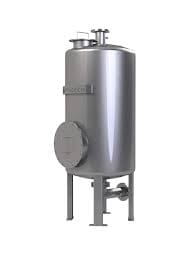
Activated Carbon Vessels
The workhorse of biogas treatment. Impregnated activated carbon removes siloxanes, H₂S, and VOCs through adsorption. Available in bulk-fill tower configurations for high-volume applications or cartridge-based systems for smaller installations.
Types: Bulk-fill towers, cartridge vessels
Media: Virgin carbon, impregnated (KOH, KI) for H₂S
Efficiency: 99.9%+ siloxane removal
Service: Carbon change-out on schedule or breakthrough
Coalescing Filters
Remove water droplets, oil aerosols, and liquid-phase contaminants from the gas stream before compression or carbon treatment. Properly dewatering the gas upstream extends carbon bed life significantly and protects compressor internals.
Placement: Upstream of compressors and carbon beds
Benefit: Extends carbon life, protects compressors
Drainage: Automatic or manual condensate drain
Gas Chiller / Dryer Packages
Refrigerated gas chillers reduce dew point to prevent condensation in downstream piping and equipment. Desiccant dryers achieve deeper dew point suppression (to -40°F) for RNG pipeline injection and cold-climate installations.
Desiccant: Dew point to -40°F
Capacity: Sized to gas flow rate and inlet conditions
Best For: Pipeline injection, cold climates, compressor protection
Particulate Filters
Pre-filters and final-stage filters remove dust, pipe scale, and carried-over solids at multiple points in the treatment train. Protect carbon beds, compressors, membranes, and engine fuel systems from abrasive particulate damage.
Final Filtration: Fine particulate downstream for engine/pipeline
Media: Pleated cartridges, bag filters, HEPA-rated
Placement: Multiple stages throughout the treatment train
Iron Sponge / Media Scrubbers
Dedicated H₂S removal using iron-oxide media for high-concentration applications. More cost-effective than activated carbon alone when H₂S levels are elevated, and often used as a first-stage scrubber upstream of carbon polishing.
Media: Iron-oxide sponge, proprietary iron media
Placement: Upstream of activated carbon
Benefit: Reduces carbon consumption for H₂S, lowers operating cost
RNG Upgrading & Membrane Systems
For pipeline-quality renewable natural gas, membrane separation or pressure swing adsorption (PSA) removes CO₂ and nitrogen to bring methane content above 95%+ and meet heating value specifications. Pre-treatment (carbon, coalescers, chillers) is critical to protect membrane life.
Output: 95%+ methane, pipeline-quality RNG
Pre-Treatment: Carbon + coalescer + chiller required
Specs: SoCalGas Rule 30, PG&E Rule 21, utility tariffs
Biogas Sources & End Uses We Serve
Landfill Gas to Energy
Reciprocating engine generators and microturbines running on landfill gas. High siloxane and VOC loads require aggressive carbon treatment.
Wastewater Digester Gas
Municipal and industrial wastewater treatment plants with anaerobic digesters. H₂S concentrations vary widely and require flexible treatment design.
RNG Pipeline Injection
Renewable natural gas projects requiring pipeline-quality gas. Full treatment train including CO₂ removal, deep drying, and final polishing to meet utility tariff specifications.
Food Waste Digesters
Commercial food waste processing and co-digestion facilities. Variable gas composition as feedstock changes, requiring adaptable filtration design.
Agricultural Digesters
Dairy, poultry, swine, and crop residue digesters. Often very high H₂S levels requiring iron-sponge pre-treatment before carbon polishing.
Boiler & Direct-Fire
Biogas combustion in boilers, dryers, and direct-fire applications. Lower purity requirements than engines, but still need H₂S removal and moisture control.
Fuel Cell Applications
Fuel cells require extremely clean gas — parts-per-billion removal of sulfur compounds and siloxanes. Multi-stage polishing with specialty carbon media.
CNG / Vehicle Fuel
Biogas-to-CNG for fleet vehicles and refuse trucks. Requires full upgrading to pipeline quality plus compression to 3,600 PSI.
Regulatory & Pipeline Standards
Biogas treatment systems operate under environmental emissions regulations, workplace exposure limits, and — for RNG projects — utility pipeline injection specifications. We design to all applicable standards and provide testing documentation.
OSHA 29 CFR 1910.1000
Workplace exposure limits for H₂S (20 ppm ceiling), CO, and VOCs. Proper gas treatment and ventilation keeps worker exposure within permissible limits.
EPA 40 CFR Part 60
New Source Performance Standards for landfill gas emissions — SOx, NOx, and VOC limits for combustion equipment. Proper gas treatment is the primary compliance tool.
Pipeline RNG Specifications
Utility tariff specs (SoCalGas Rule 30, PG&E Rule 21, Southwest Gas) for methane content, heating value, H₂S, moisture, CO₂, siloxanes, and total sulfur.
LCFS / RFS Pathways
California Low Carbon Fuel Standard and EPA Renewable Fuel Standard pathway requirements. Proper gas conditioning and documentation are required for credit generation.
Related Resources
Get Your Biogas Treatment Sized Right
Tell us about your gas source, flow rate, contaminant profile, and end-use requirements. We’ll design a multi-stage treatment train that protects your equipment and meets your emissions or pipeline purity specs.
Serving biogas facilities across Arizona, California, Nevada, New Mexico, and Utah.