
DustHog MCB · Self Contained Crossflow Collector
DustHog MCB Crossflow Backdraft Wall Collector
When the part is too big to hood and the layout changes every week, chasing each station with an arm stops making sense. The MCB puts a wall behind the work and pulls the whole bay across it, so capture happens because of where people stand rather than because somebody moved something.
Your MCB unit, ProTura cartridges, afterfilters, pulse controllers and replacement parts ship from us anywhere in the country, with one stated price on your quote.
DustHog rates the MCB for non combustible dry dust. That is DustHog’s own application field, not a caveat we are adding. If your dust is combustible, a self contained wall unit recirculating into an open bay is the wrong shape of answer, and the conversation moves to the SFC or a purpose-designed system. More on that below.
At a glance
Capture without anything hanging over the work
Source capture arms are the right answer when the work sits still and somebody will move the hood. Crossflow is the answer when neither of those holds. The unit becomes the back wall of the station and draws air horizontally past the operator and the part, so the capture zone is the whole bay rather than a point.
DustHog describes it as a completely self contained system offering high filtration efficiency, freedom from source capture obstructions and easy maintenance. The middle one is the point. Nothing hangs over the work, nothing is in the way of a crane, and nothing has to be repositioned between parts.
Three sizes cover 4,000 to 11,500 CFM, and the practical difference between them is how wide a working face you are trying to hold, not how much dust you are making.
- ModelsThree, MCB-03 to MCB-09
- Airflow4,000 to 11,500 CFM
- Motor3.0 to 10 hp, 460V 3 ph
- Efficiency95% or HEPA afterfilter
- CleaningReverse pulse, 1.82 SCFM per pulse
- ConfigurationsNine orderable
- Filter mediaRound media cartridge, ProTura
- Media areaNot published by DustHog
- Compressed air1.82 SCFM per pulse
Inside and in use
See the MCB wall with people working at it
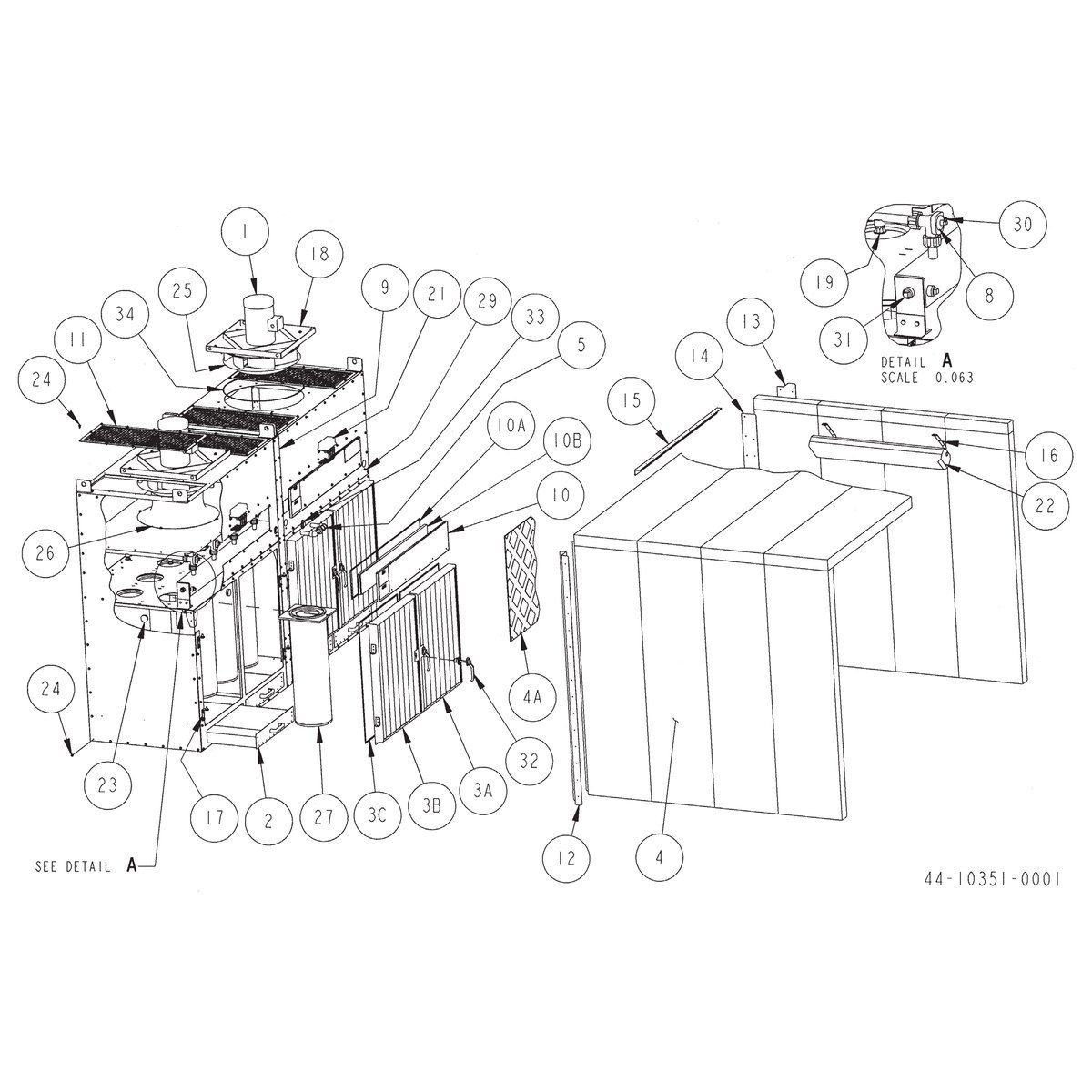
You can see how it is built and how it sits on a site before you talk to anyone. Select a photo to see it full size.



The models
Three sizes, three wheel and sprinkler options, nine part numbers
DustHog publishes nine orderable builds. Three airflow sizes, and each one available with an aluminum wheel, a steel wheel, or a steel wheel with a sprinkler connector. All nine run 460 volt three phase and take an external motor starter.
| Part number | Model | Airflow | Motor | Current | Wheel and options |
|---|---|---|---|---|---|
| 02-10578-31AL | MCB-03 | 4,000 CFM | 3.0 hp | 4.5 A | Aluminum wheel |
| 02-10578-31ST | MCB-03 | 4,000 CFM | 3.0 hp | 4.5 A | Steel wheel |
| 02-10578-31ST-S | MCB-03 | 4,000 CFM | 3.0 hp | 4.5 A | Steel wheel, sprinkler connector |
| 02-10578-61AL | MCB-06 | 9,500 CFM | 7.5 hp | 10.9 A | Aluminum wheel |
| 02-10578-61ST | MCB-06 | 9,500 CFM | 7.5 hp | 10.9 A | Steel wheel |
| 02-10578-61ST-S | MCB-06 | 9,500 CFM | 7.5 hp | 10.9 A | Steel wheel, sprinkler connector |
| 02-10578-91AL | MCB-09 | 11,500 CFM | 10 hp | 14 A | Aluminum wheel |
| 02-10578-91ST | MCB-09 | 11,500 CFM | 10 hp | 14 A | Steel wheel |
| 02-10578-91ST-S | MCB-09 | 11,500 CFM | 10 hp | 14 A | Steel wheel, sprinkler connector |
The wheel choice is about what is in your airstream. An aluminum wheel is lighter and the default. A steel wheel is the answer where the air carries anything abrasive, and it is the one to specify if there is grinding upstream of the unit. It is a small line on the order and an expensive thing to change afterward, so it is worth deciding deliberately rather than taking the default.
The sprinkler connector is a fire protection decision, not a feature. DustHog builds a version with a connector so the unit can be tied into your building system. Whether you need it is a question for your fire protection engineer and your local authority rather than for us, and it is far easier to order the connector version than to add one later. If there is any chance the answer is yes, order the ST-S.
Footprint, weight and the wall it needs. DustHog publishes the family at 42 in. deep, 36 to 116 in. wide and 98 to 107 in. high, weighing 1,090, 1,725 or 2,400 lbs depending on the size. That width range is the real sizing question: the unit has to be as wide as the working face you want to hold, which is usually what picks the model rather than the CFM figure. Powder coated mild steel in Hog Gray.
What you choose
Five decisions, and the starter is the one that stops installs
The model settles the airflow and the working face. What is left is what the air passes through on the way out and how the unit gets started.
| Choice | Options | What it changes |
|---|---|---|
| Size | MCB-03, MCB-06 or MCB-09 | Airflow and how wide a face it holds |
| Blower wheel | Aluminum or steel | How it holds up to abrasive air |
| Sprinkler connector | With or without | Whether it ties into building fire protection |
| Pulse control | Pulse timer or digital pulse controller | Whether cleaning runs on a clock or on pressure |
| Afterfilter | 95% or HEPA | What comes out at the discharge, into an occupied bay |
The motor starter is not included, and it is its own line. DustHog builds the MCB for external control and an external motor starter. That is a real item and a real install task, and it is the single most common thing left off an order. We quote it with the machine so your electrician is not standing in front of a 10 hp unit on install day with nothing to start it.
Digital pulse control is worth the upgrade on a variable process. A pulse timer cleans on a clock whether the cartridges need it or not, which spends compressed air on a light shift and underclean on a heavy one. A digital controller cleans against differential pressure instead. On a bay whose workload changes week to week, that pays for itself in compressed air and cartridge life.
The afterfilter matters more here than on a ducted machine. The MCB discharges back into the bay your people are standing in. That makes the afterfilter the last thing between the process and the air everyone breathes for the rest of the shift, with no stack to send a miss out through. On welding and grinding it is usually the right call.
Media and filtration
Round cartridges, and what recirculating air asks of them
DustHog fits the MCB with round media cartridges, and ProTura nanofiber is the line built for this duty. Nanofiber media holds the dust cake on the surface rather than letting it drive into the depth of the media, which is what lets a cartridge pulse clean and come back near its starting pressure drop instead of climbing a little further every week.
DustHog publishes no media area figure for the MCB on its current catalog, so this page does not carry one. If cartridge life is the number your decision turns on, that is a factory question and we will ask it rather than estimate.
What DustHog does publish is the compressed air: 1.82 SCFM per pulse. A collector that pulses more often than it needs to is a standing load on your compressor all shift, which is exactly the argument for the digital pulse controller over the timer.
Fire retardant media is worth a conversation on any bay with grinding or hot work upstream, and it is not a substitute for a spark arrestor or for the sprinkler connector. We will say so rather than let FR media do work it was not designed for.
Cleaning and ownership
Pulse cleaning, and what a wall unit asks of you
What the collector needs from you
Clean, dry compressed air for pulsing at 1.82 SCFM per pulse, and a 460 volt three phase feed with a starter. Air carrying moisture or compressor oil turns cartridge dust into mud, and a collector fed wet air fails in a way that looks exactly like a filter problem and is not.
If your compressed air system does not already have proper drying and filtration at the point of use, that is part of this project rather than a separate one, and it goes on the quote instead of surfacing after startup.
What service looks like
Everything is at floor level and reachable, which is the quiet advantage of a wall unit over anything hung from a ceiling. Cartridge changes are a normal maintenance task rather than a lift and a permit.
The thing to plan is access behind and around the unit. It is up to 116 in. wide and 2,400 lbs, and a bay that gets rearranged around it can end up with the service side blocked by exactly the kind of long part the collector was bought to handle.
Crossflow only works if the bay stays a bay. The capture depends on air moving horizontally from the open side of the station across the work and into the unit. Park a rack, a bench or a pallet of stock in the middle of that path and you have split the airflow. It is worth going over the layout with whoever runs your floor, once, at startup.
A hard boundary
Non combustible dust only, and that is DustHog’s own line
DustHog’s application field for the MCB reads non combustible dry dust. We are not going to quote around that. A collector rated for nuisance dust does not become a combustible dust machine because the airflow happens to line up, and a self contained unit discharging into an open bay is the last place to find that out.
NFPA 660 took effect January 1, 2026 and consolidated NFPA 61, 484, 652, 654, 655, and 664. NFPA 68 for venting and NFPA 69 for explosion prevention remain separate referenced standards. Your dust hazard analysis has to be reviewed at least every five years and whenever the process changes.
The part shops underestimate is how many ordinary materials test combustible. Wood, most grains and sugars, many plastics, aluminum, magnesium, titanium and zirconium all sit inside that scope, and published KSt and Pmax values screen for hazard rather than design for it. Design requires lab testing your actual dust, because particle size and moisture move the numbers.
Aluminum, magnesium, titanium and zirconium go to wet collection under NFPA 660’s stated preference. You get design documentation you can take to your own engineers. For your DHA, go straight to DHA Report Group and request the intake form. The DHA itself is completed by you or by a qualified third party. We do not author it and we do not stamp drawings.
What it is built for
Open bays where the part is big and the layout keeps moving
DustHog’s own fields read dust, fume and smoke on a stationary media collector for non combustible dry dust. Where that lands is a station that cannot be hooded.
Structural and heavy weld bays where the part arrives on a crane. Grinding and finishing cells where the operator works all the way around the piece. Training floors where a dozen students move constantly and nobody is going to reposition an arm between cuts. In each case the common factor is that source capture would work if only somebody would aim it, and crossflow removes that requirement.
It shows up most in welding and metal fabrication and in trade and vocational schools. Where the bay also needs general room air cleaning above it, the SCA is what usually sits alongside.
Fit check
When the MCB is not right for you
Your dust is combustible
This is the first question, not the last. DustHog rates the MCB for non combustible dry dust. Wood, grain, sugar, many plastics and reactive metals all commonly test combustible, and that changes the machine, the protection strategy and the standard you are working to. See combustible dust collectors.
You can get a hood on the work
If the process sits still and somebody will move an arm to it, source capture does more with a fraction of the air. Crossflow moves thousands of CFM to hold a whole bay. An extraction arm holds a station on a few hundred.
The bay cannot stay clear
Crossflow depends on an unobstructed horizontal path across the work. If racks, stock or benches are going to live in the middle of that path, the airflow splits and the capture goes with it. Ambient collection is more forgiving of a floor that keeps changing.
You do not have 460 volt three phase
DustHog publishes all nine MCB builds at 460V three phase. If that is not what is in the building, say so early. It is solvable, but it changes the answer and it should not be discovered by an electrician on install day.
You need more than 11,500 CFM
That is the top of this family. A larger bay or a whole line moves you to the modular SFC, which scales in cartridge count and runs to 102,000 CFM.
Your contaminant is oil mist
Machining coolant mist is a different filtration problem and a cartridge collector is the wrong machine for it. That work goes to the SmogHog side of the line.
MCB questions
How much air does the MCB move?
4,000 CFM on the MCB-03, 9,500 on the MCB-06 and 11,500 on the MCB-09. The size is usually picked by how wide a working face you need to hold rather than by the airflow figure on its own.
What is a crossflow or backdraft collector?
The unit becomes the back wall of the station and pulls air horizontally across the work and past the operator into the filters. Nothing hangs over the work, so there is no arm to reposition and nothing in the way of a crane or a long part.
What is the difference between the nine part numbers?
Three sizes, each in three configurations: aluminum wheel, steel wheel, or steel wheel with a sprinkler connector. Steel is for abrasive air. The sprinkler connector lets the unit tie into building fire protection and is far easier to order than to add later.
Can I use it on combustible dust?
No. DustHog’s application field reads non combustible dry dust. Combustible dust needs a collector designed for it, with a protection strategy driven by your dust hazard analysis and lab testing of your actual material.
Does it come with a motor starter?
No, and this is the item most often left off an order. DustHog builds the MCB for external control and an external motor starter. We quote it with the machine by part number.
Pulse timer or digital pulse controller?
A timer cleans on a clock. A digital controller cleans against differential pressure, so it does not spend compressed air on a light shift or underclean on a heavy one. On a bay whose workload varies, the controller pays for itself.
What power and compressed air does it need?
460 volt three phase at 60 Hz, drawing 4.5, 10.9 or 14 amps depending on the size, plus clean dry compressed air at 1.82 SCFM per pulse.
How big is it?
42 in. deep, 36 to 116 in. wide and 98 to 107 in. high, weighing 1,090 to 2,400 lbs depending on the model. The width is the number that matters, because it has to match the working face you are trying to hold.
Tell us the bay, the process, and what is at the wall
Those three answers pick the size, the wheel, the pulse control and whether crossflow is the right shape of answer at all. You get back a full part number and a firm price.
Not sure whether your dust is combustible? Book a free system review, or start with the NFPA 660 checklist.