
DustHog XA and TSA · Source Capture Extraction Arms
DustHog XA and TSA Source Capture Extraction Arms
The arm is where a fume system either works or does not. It is the one part an operator touches every day, and if it will not hold position or will not reach, the rest of the money you spent stops mattering. DustHog builds these to be moved and to stay where they are put.
Your arms, mounting kits, hood switches, work lights and replacement hose ship from our store at the prices shown below, or on a configured quote, anywhere in the country.
An arm is the capture end of a system, not a collector. It has no fan, no filter and no motor. It needs a collector pulling the right airflow through it and duct sized to deliver that airflow without eating it in friction. If you are shopping for an arm on its own, tell us what it is connecting to, because that is the part that decides whether the arm performs.
The short answer. DustHog XA arms come in 6 in. and 8 in. diameters and 7, 10 or 12 ft lengths, as a wall mount arm or a portable arm for the VP 750 and VP 1500 collectors. The arm itself carries no airflow rating; the collector or fan behind it sets the airflow. In the systems we design, a 6 in. arm typically pairs with about 800 CFM and an 8 in. arm with about 1,000 CFM. The TSA telescopic arm is the compact choice at 21 to 22 lb, against 50 to 95 lb for the XA. Every wall arm needs its matching wall mount kit: 03-10615-U for 6 in. and 03-10611-U for 8 in. Prices and part numbers for all fourteen arms are in the table below.
At a glance
Capture at the source is the cheapest air you will ever move
A hood parked a foot from the arc catches the fume with a few hundred CFM. Cleaning the same fume out of the room after it has spread takes thousands. That arithmetic is why source capture keeps winning on both the exposure number and the power bill.
DustHog’s own literature calls the arm what it is: an engineering control, positioned in the work zone to remove dust, smoke and fume at the generation source before it reaches the operator’s breathing zone. It is the front end of a local exhaust ventilation system, and the standard it has to meet is whether the hood is where the work is.
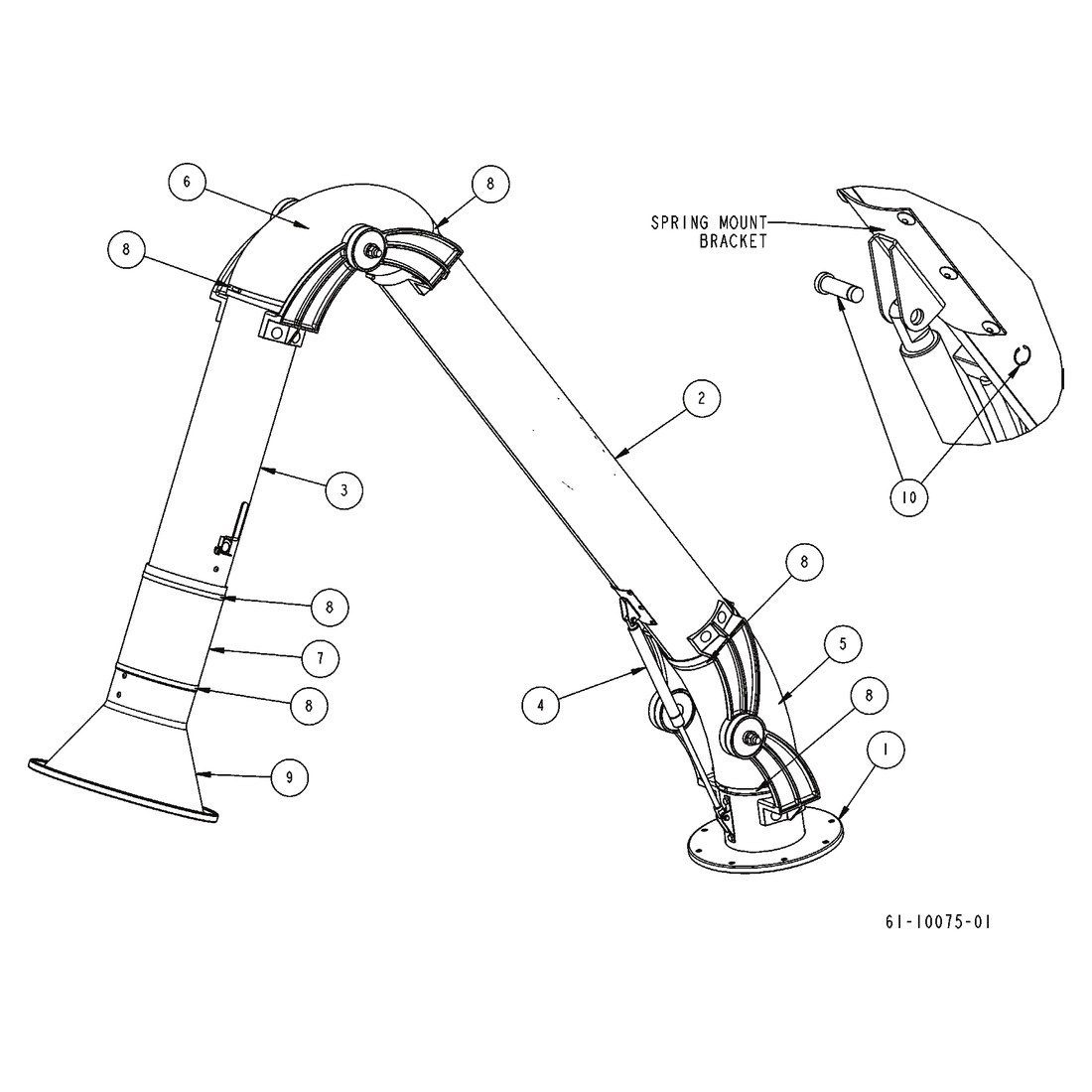
The design details all serve that. A swivel base with two or three pivot points, joint tension you can adjust so the arm is neither stiff nor sagging, and support hardware outside the airstream so it is not adding pressure drop or collecting dust where you cannot reach it.
- ModelsXA wall, XA portable, TSA telescopic
- AirflowSet by the collector; no arm rating published
- Reach4 to 12 ft
- Diameter6 or 8 in.
- ConfigurationsFourteen orderable
- Tube materialPowder coated aluminum
- HoseNeoprene coated polyester, steel wire helix
- Operating temperature35 to 165 F
- MountingWall, kit sized to the diameter
- CounterbalanceGas springs on portable, tension springs on wall arms
- JointsCast aluminum friction disk, adjustable from outside
- Structural warranty10 years on major structural parts
Reach and parts
See how the arm moves and what it is made of
You can see how it is built and how it sits on a site before you talk to anyone. Select a photo to see it full size.


The models
Three arm types, and the diameter sets the air before anything else does
DustHog offers fourteen orderable arms: wall mount and portable XA arms in two diameters and three lengths, plus the TSA telescopic. Diameter decides how much air the arm can carry, length decides the reach, and the type decides how the arm gets from the wall to the work.
| Part number | Type | Reach | Diameter | Typical airflow* | Ship weight | Price |
|---|---|---|---|---|---|---|
| 01-10163 | XA wall articulated | 7 ft | 6 in. | About 800 CFM typical | 50 lb | $2,166.00 |
| 01-10164 | XA wall articulated | 10 ft | 6 in. | About 800 CFM typical | 52 lb | $2,276.00 |
| 01-10165 | XA wall articulated | 12 ft | 6 in. | About 800 CFM typical | 55 lb | $2,388.00 |
| 01-10150 | XA wall articulated | 7 ft | 8 in. | About 1,000 CFM typical | 90 lb | $2,368.00 |
| 01-10151 | XA wall articulated | 10 ft | 8 in. | About 1,000 CFM typical | 92 lb | $2,528.00 |
| 01-10152 | XA wall articulated | 12 ft | 8 in. | About 1,000 CFM typical | 95 lb | $2,549.00 |
| 01-10171 | TSA telescopic | 4 to 6.5 ft | 6 in. | About 800 CFM typical | 21 lb | $1,416.00 |
| 01-10172 | TSA telescopic | 4 to 6.5 ft | 8 in. | About 1,000 CFM typical | 22 lb | $1,576.00 |
| 01-10160 | XA portable, 6 in., for the VP 750 | 7 ft | 6 in. | 750 CFM | 50 lb | $1,879.00 |
| 01-10161 | XA portable, 6 in., for the VP 750 | 10 ft | 6 in. | 750 CFM | 52 lb | $2,037.00 |
| 01-10162 | XA portable, 6 in., for the VP 750 | 12 ft | 6 in. | 750 CFM | 55 lb | $2,148.00 |
| 01-10147 | XA portable, 8 in., for the VP 1500 | 7 ft | 8 in. | 1,500 CFM | 90 lb | $2,055.00 |
| 01-10148 | XA portable, 8 in., for the VP 1500 | 10 ft | 8 in. | 1,500 CFM | 92 lb | $2,201.00 |
| 01-10149 | XA portable, 8 in., for the VP 1500 | 12 ft | 8 in. | 1,500 CFM | 95 lb | $2,310.00 |
*DustHog does not publish an airflow rating for the arm itself; the collector or fan sets it. Typical figures are what each diameter is usually paired with. Portable arms run at their VP collector’s rated airflow. Ship weights are from the DustHog XA owner’s manual. Prices are live from our store.
Six inch or eight inch is the first decision, not the last. DustHog does not publish an airflow rating for the arm itself, because the fan or collector sets the air. In practice a 6 in. arm pairs with about 800 CFM and an 8 in. arm with about 1,000 CFM. Light soldering, small MIG work and most bench tasks live comfortably in the 6 in. band. Heavy stick welding, flux core, plasma and anything throwing a lot of visible smoke wants the 8 in. Going up a size later is not a swap, it is a new arm and often a new duct branch, so it is worth being honest about the process on day one.
Articulated or telescopic. The XA articulated arms fold and reach out to 7, 10 or 12 ft, which is what you want when the work sits away from the wall or moves along a bench. The TSA telescopic gives 4 to 6.5 ft with a 2.5 ft telescopic travel in a much lighter package, at 21 to 22 lbs against 50 to 95 lbs for the XA. On a tight station, or on a wall that will not carry much, the TSA is the better answer.
The portable arms belong to the VP collectors. The 6 in. portable arms (01-10160 to 01-10162) mount on the VP 750, and the 8 in. portable arms (01-10147 to 01-10149) mount on the VP 1500, so they run at that unit’s rated airflow. The arm is ordered separately from the VP base unit rather than assumed to be on it, so if you have a VP collector, this is the arm line for it. The weights in the table are DustHog’s published shipping weights from the XA owner’s manual.
What you choose
Five decisions, and the mounting kit is the one that gets forgotten
Diameter and length settle the performance. The rest is about how the arm attaches to your building and what the operator can do with it once it is up.
| Choice | Options | What it changes |
|---|---|---|
| Diameter | 6 in. or 8 in. | The airflow band, and what process it can hold |
| Reach | 7, 10 or 12 ft articulated, or 4 to 6.5 ft telescopic | How much of the station one arm actually covers |
| Mounting kit | Wall kit, sized to the 6 or 8 in. arm | How the arm ties to your wall or column |
| Hood mounted switch | On or off | Whether the operator can start the collector from the hood |
| Work light | On or off | Whether the hood also lights the weld or the bench |
Mount kits, booms and fans
Wall arms do not include the bracket. These are the lines that get forgotten, with live pricing from our store.
| Part number | Item | What it does | Price |
|---|---|---|---|
| 03-10615-U | Wall mount kit, 6 in. XA and TSA arms | Required for every 6 in. wall arm | $279.00 |
| 03-10611-U | Wall mount kit, 8 in. XA and TSA arms | Required for every 8 in. wall arm | $310.00 |
| 03-10672 | Extension boom, 6 in. XA wall arm | 8 ft wall mounted boom that carries the arm farther from the wall | $2,190.00 |
| 03-10671 | Extension boom, 8 in. XA wall arm | 8 ft wall mounted boom that carries the arm farther from the wall | $3,619.00 |
| 03-10673 | Extraction fan, 6 in., 1 HP, 115/1/60 | Mounts on the wall bracket to make a simple exhaust arm | $2,954.00 |
| 03-10589-U | Extraction fan, 8 in., 1 HP, 115/1/60 | Mounts on the wall bracket to make a simple exhaust arm | $3,045.00 |
The mounting kit is a real line, and it is diameter specific. DustHog builds the wall kit separately for the 6 in. and the 8 in. arm. It is the single most common thing left off an arm order, and it is the thing that stops an install cold on the morning the arms arrive. We put it on the quote by part number every time, and we ask what the arm is landing on, because a steel column, a block wall and a metal stud wall are three different fastening problems.
The hood switch is worth more than it costs. A collector that has to be started at a panel across the bay gets left running all shift or does not get started at all. A switch at the hood puts the decision where the operator already is, which is the difference between a fume system that runs when welding happens and one that runs on habit.
The damper is how you make multiple arms work. Every XA arm ships with a hood screen and a manual flow damper at the hood. The TSA ships with its hood but without a damper, so plan the balancing elsewhere on a TSA branch. On a single arm it lets the operator dial back the pull on light work. On a system with several arms on one collector it is how the system gets balanced, so the arm at the end of the duct run gets its share instead of the closest arm taking everything. Startup support covers setting those rather than leaving them wide open.
Construction and materials
What the arm is made of, and why each part is that material
DustHog builds the rigid ducts and the capture hood in aluminum with a black powder coat, the elbows in black anodized cast aluminum, and the base assembly, spring brackets and hood brackets in steel with a black powder coat. Every powder coated component is rated to a minimum 500 hour salt spray test, which is the part that matters in a shop with coolant mist or a wash bay nearby.
The flexible hose is a single ply neoprene coated polyester fabric reinforced with a spring steel wire helix, built from UL 94V0 rated materials. That rating is about the hose material resisting ignition, and it is a real design choice rather than a marketing line. It is not the same thing as a spark arrestor, and we will say so rather than let it stand in for one.
The support system sits outside the airflow. That is worth noticing, because the alternative puts springs and linkages inside the duct where they add pressure drop, collect dust and cannot be adjusted without opening the airstream. External supports mean the arm can be re-tensioned by hand from the outside on a Tuesday afternoon.
Operating range is 35 to 165 degrees F. On most fume work that is not a constraint, but on a hot process or a hood that ends up close to radiant heat it is, and it is better checked before the order than discovered by a soft hose.
Positioning and ownership
What an arm asks of the person using it
The hood has to move
Capture falls off fast with distance. An arm parked three feet back from the arc is doing a fraction of the work it does at a foot, and no amount of collector fixes that. This is the whole ballgame on a source capture system.
It is a five minute conversation with the operators, and it is the difference between a system that hits its numbers and an expensive fixture on the wall. Startup support covers it rather than leaving it to the manual.
Tension is a maintenance item
The joint tension is adjustable so the arm holds position through its whole range. Over a few years of daily use that tension drifts, and a sagging arm is one an operator stops bothering with.
It takes minutes to set with the arm still on the wall, because the hardware is outside the airstream. Put it on the same schedule as the filter check and the arm keeps behaving like it did on day one.
Hose and hood screen are wear parts. The hose takes the abuse of daily repositioning and the hood screen catches what would otherwise go down the duct. Both are replaceable, both are cheap next to an arm, and both are worth keeping one of on the shelf. We list them with the arm so you know what the consumables actually are before you own it.
A hard boundary
An arm does not decide whether your dust is combustible
DustHog names welding fume, oil mist from machining coolants, soldering, bulk powders and other miscellaneous dusts for these arms. If what you are capturing is a combustible dust, the arm is the least of the design questions, because the duct, the collector, the isolation and the protection strategy all change and they change as a system.
NFPA 660 took effect January 1, 2026 and consolidated NFPA 61, 484, 652, 654, 655, and 664. NFPA 68 for venting and NFPA 69 for explosion prevention remain separate referenced standards. Your dust hazard analysis has to be reviewed at least every five years and whenever the process changes.
Wood, most grains and sugars, many plastics, aluminum, magnesium, titanium and zirconium all commonly test combustible. Published KSt and Pmax values screen for hazard rather than design for it, because particle size and moisture move the numbers on your actual material. Aluminum, magnesium, titanium and zirconium go to wet collection under NFPA 660’s stated preference, with outdoor dry collection as the recognized alternative.
You get a design drawing you own and can take to your own engineers. For your DHA, go straight to DHA Report Group and request the intake form. The DHA itself is completed by you or by a qualified third party. We do not author it and we do not stamp drawings.
What it is built for
Work that sits still long enough for a hood to reach it
DustHog lists the applications directly: welding fume, oil mist from machining coolants, soldering, bulk powders and other miscellaneous dusts. The common thread is a known generation point a person can bring a hood to.
On your floor that is a weld bench, a grinding station, a solder line, a bag dump, a small parts cleaning station. Anywhere the operator stands in one place and the fume comes off one spot, an arm pulling around 800 to 1,000 CFM beats moving the whole room.
Arms tie into everything on the DustHog side. The SCB takes two of them off a ceiling unit, the VP portable and VF fixed units each take one, and a SFC with a duct main will carry a row of them. It shows up most in welding and metal fabrication and in trade and vocational schools.
Fit check
When an extraction arm is not right for you
The work moves around the bay
An arm captures what is in front of it. If the part is on a crane, or a welder walks the length of a long weldment, no arm follows that. Ambient collection with the SCA is the honest answer there, and on a lot of shops the right answer is arms on the fixed stations and ambient over everything else.
Nobody is going to reposition the hood
We would rather say this before the quote than after the install. If the culture is not there, the money does more work as a downdraft bench, where capture happens because of where the work sits rather than because somebody decided to move something.
You have no collector for it to connect to
An arm has no fan and no filter. It needs a collector sized to pull its airflow and duct that delivers it. If there is nothing on the other end yet, start with the collector conversation and the arm falls out of it.
The process runs hotter than 165 degrees F at the hood
That is DustHog’s published operating range. On ordinary welding it is not a constraint. On an oven door, a furnace tap or a hood sitting in radiant heat it is, and the answer becomes hard duct and a heat rated hood rather than a flexible arm.
You need reach beyond 12 ft from one mount
Twelve feet is the longest articulated arm DustHog publishes here. Past that you are looking at a boom arm, a second mounting point, or moving the drop closer to the work. Stretching an arm to cover more than it should is how you end up with a hood that never quite reaches and an operator who stops trying.
Extraction arm questions
How much air does an arm need?
DustHog does not publish an airflow rating for the arm, because the collector or fan sets it. In the systems we design, a 6 in. arm typically pairs with about 800 CFM and an 8 in. arm with about 1,000 CFM. The portable arms run at their VP collector’s rated airflow: 750 CFM on the VP 750 and 1,500 CFM on the VP 1500. Those figures are what the collector and duct have to deliver at the hood, not what the arm produces on its own.
What length should I order?
Long enough that the hood reaches every part of the work without the operator fighting it, and no longer. DustHog publishes 7, 10 and 12 ft articulated arms and a 4 to 6.5 ft telescopic. We go through the reach against the mounting point and the station with you before the order rather than after.
Does the mounting bracket come with the arm?
The wall mounting kit is its own line and it is sized to the 6 or 8 in. arm. We quote it by part number alongside the arm, and we ask what wall or column it is landing on, because that changes the fastening.
What is the difference between the XA and the TSA?
The XA is an articulated arm that folds and reaches 7, 10 or 12 ft, weighing 50 to 95 lbs. The TSA is a telescopic arm with 4 to 6.5 ft of reach at 21 to 22 lbs. The TSA suits a tight station or a wall that will not carry much; the XA suits work that sits farther out or moves along a bench.
Will the arm hold its position?
That is what the swivel base, the two or three pivot points and the adjustable joint tension are for. The tension is set from outside the airstream, so it can be tuned to the operator and re-tuned years later without opening anything up.
Can I run several arms off one collector?
Yes, and the manual flow damper at each hood is how the system gets balanced so the far arm gets its share. The collector has to be sized for the arms running at once rather than for all of them at full pull, which is a sizing conversation worth having up front.
Is the hose fire resistant?
DustHog builds the flexible hose from UL 94V0 rated materials, which is about the hose resisting ignition. That is not the same as a spark arrestor, and on a process throwing hot particulate the spark control is a separate part of the design.
What are the wear parts?
The hose and the hood screen. Both take the daily handling, both are replaceable, and both are inexpensive next to the arm. Keeping one of each on the shelf keeps a station running.
Tell us the station, the process, and what the arm connects to
Those three answers pick the diameter, the length, the arm type and the mounting kit, and they tell us whether the collector on the other end can actually feed it. You get back a full part number and a firm price.
Not sure whether your dust is combustible? Book a free system review, or start with the NFPA 660 checklist.