
SmogHog MSH · Machine Mounted Electrostatic
SmogHog MSH Machine Mount Mist Collector
Your mist problem is two or three machines, not the whole bay. The MSH sits on top of the machine, pulls at the enclosure, and puts the cleaned air back in the room, so nothing gets ducted and nothing gets exhausted. The cells wash and go back in, which means no filter to reorder for as long as somebody keeps washing them.
Your MSH unit, collection cells, Mist-Stop prefilters, and replacement parts ship from us anywhere in the country, with one stated price on your quote.
Six choices make an MSH
You are picking size, orientation, single or double pass, airflow direction, power pack, and inlet collar. Thirty-six combinations come out of those six, and none of them is a custom build. The one that costs the most to get wrong is the pass count, so that is the one we work through first.
What it is
A precipitator small enough to live on the machine
Mist and smoke off oil and water based coolants draw into a Mist-Stop coalescing prefilter, then through an ionizer that charges what is left, then onto grounded collection plates. SmogHog rates it at more than 99% removal by mass, with greater than 90% removal of 0.3 micron liquid particles independently verified in accordance with EN 1822-5.
The cleaned air goes straight back into the plant. There is no roof penetration, no makeup air to replace, and no heating or cooling you are paying for twice.
It mounts on any flat surface, which in practice means the top of the machine cabinet or an angle iron base beside it. Collected coolant leaves through a 1.5 inch NPT drain, with a drain loop or a drain bottle available depending on how you want to catch it.
- ModelsMSH-05, MSH-11
- Airflow500 or 1,100 CFM nominal
- EfficiencyMore than 99% by mass
- Sub-micronMore than 90% at 0.3 µm liquid
- Ionizer10.0 to 11.8 kVDC
- Collection cell5.0 to 7.5 kVDC
- Drain1.5 in. NPT
- Configurations36 orderable
The two sizes
| Model | Nominal airflow | Adjustable range | Blower | Power | Sound | Weight |
|---|---|---|---|---|---|---|
| MSH-05 | 500 CFM | 300 to 500 CFM | 0.25 hp | 115/1/60 | 64.9 dBA | 115 lbs |
| MSH-11 | 1,100 CFM | 750 to 1,500 CFM | 1.45 hp | 230/1/60 | 73.5 dBA | 192 lbs |
Both are single phase, and that is usually good news. The 05 runs on 115 volts and the 11 on 230, so neither one waits on an electrician to pull three phase to a machine that already has power at it. Weights above are the base units. A double pass build is longer and heavier, and we give you the exact footprint with the quote rather than making you find out at the loading dock.
The unit
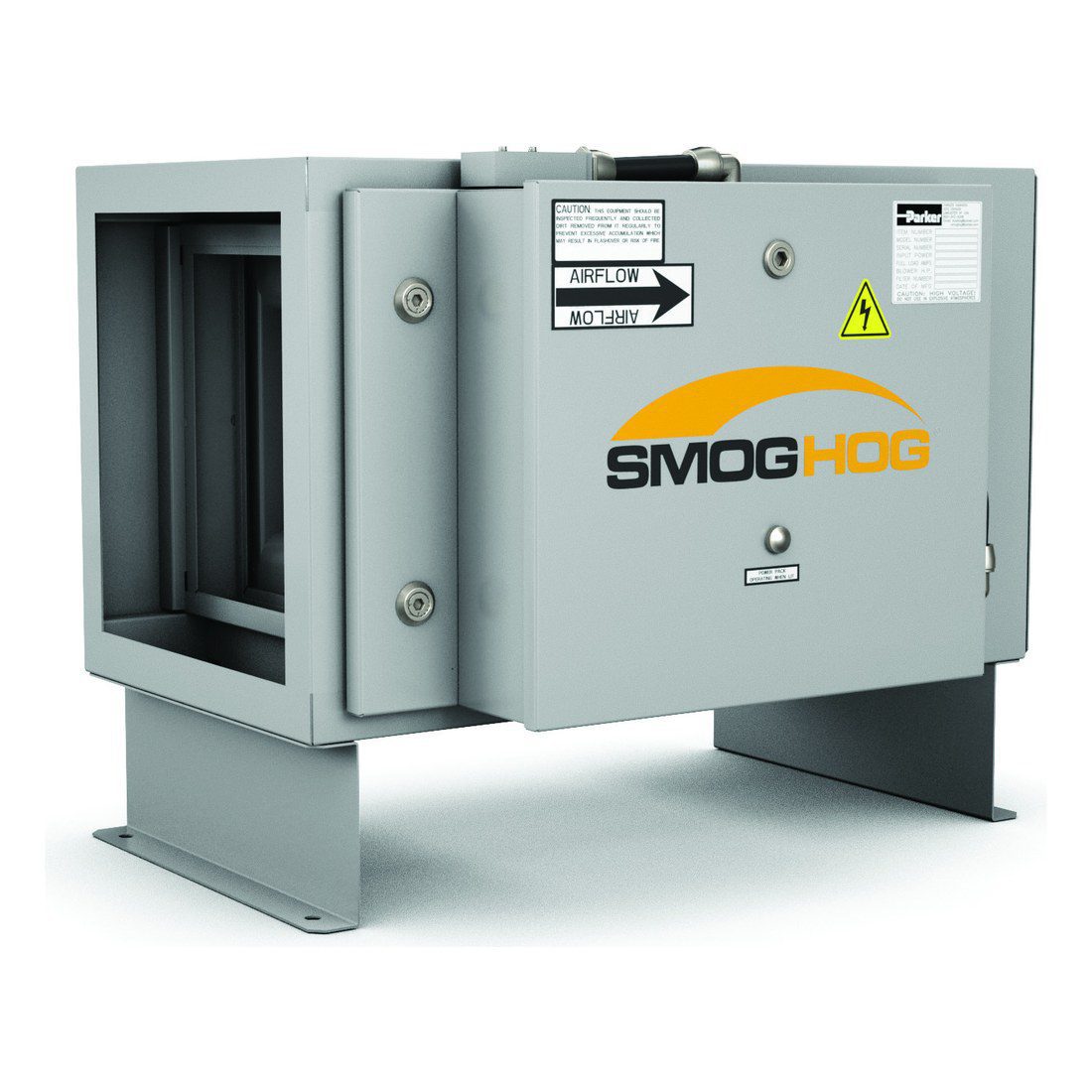
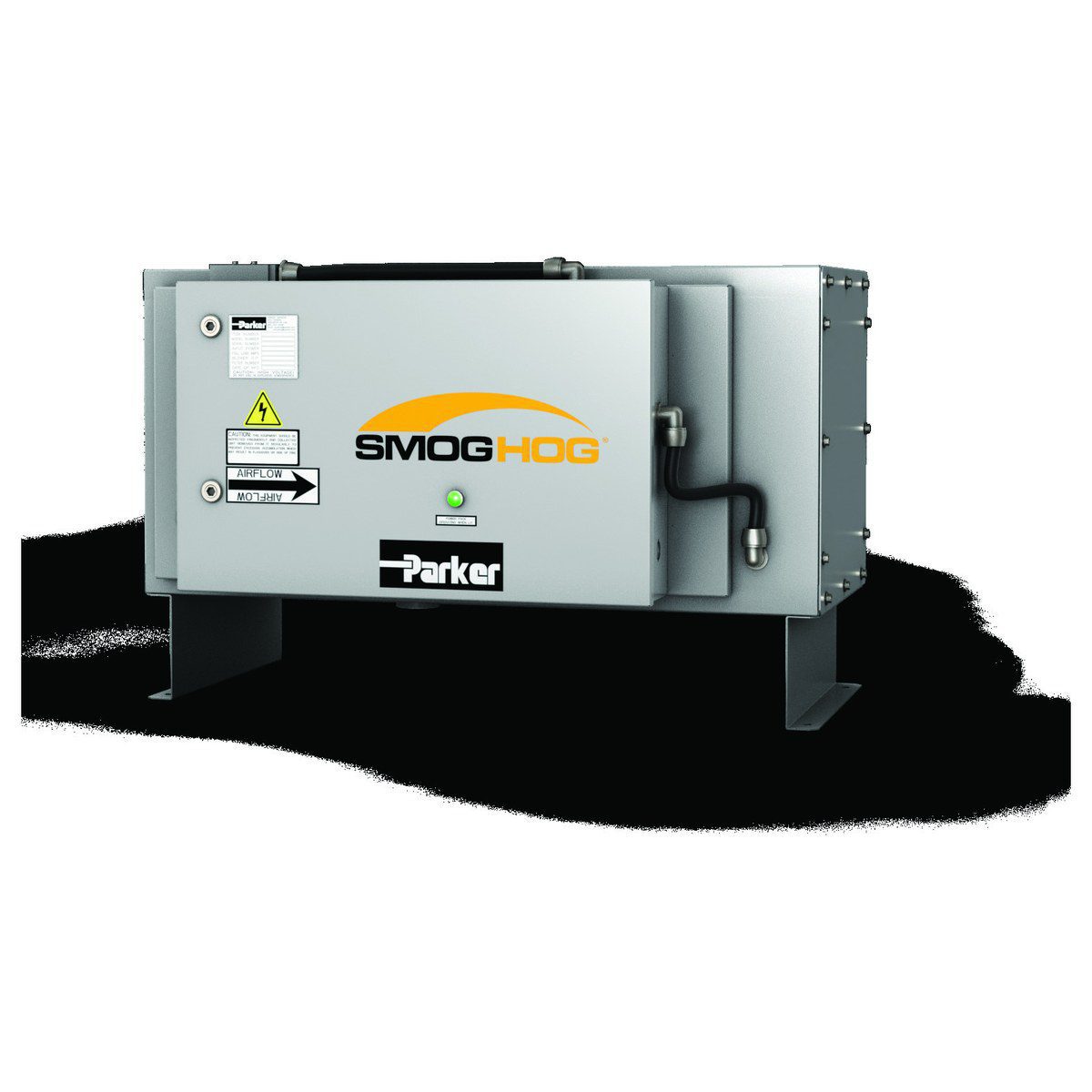
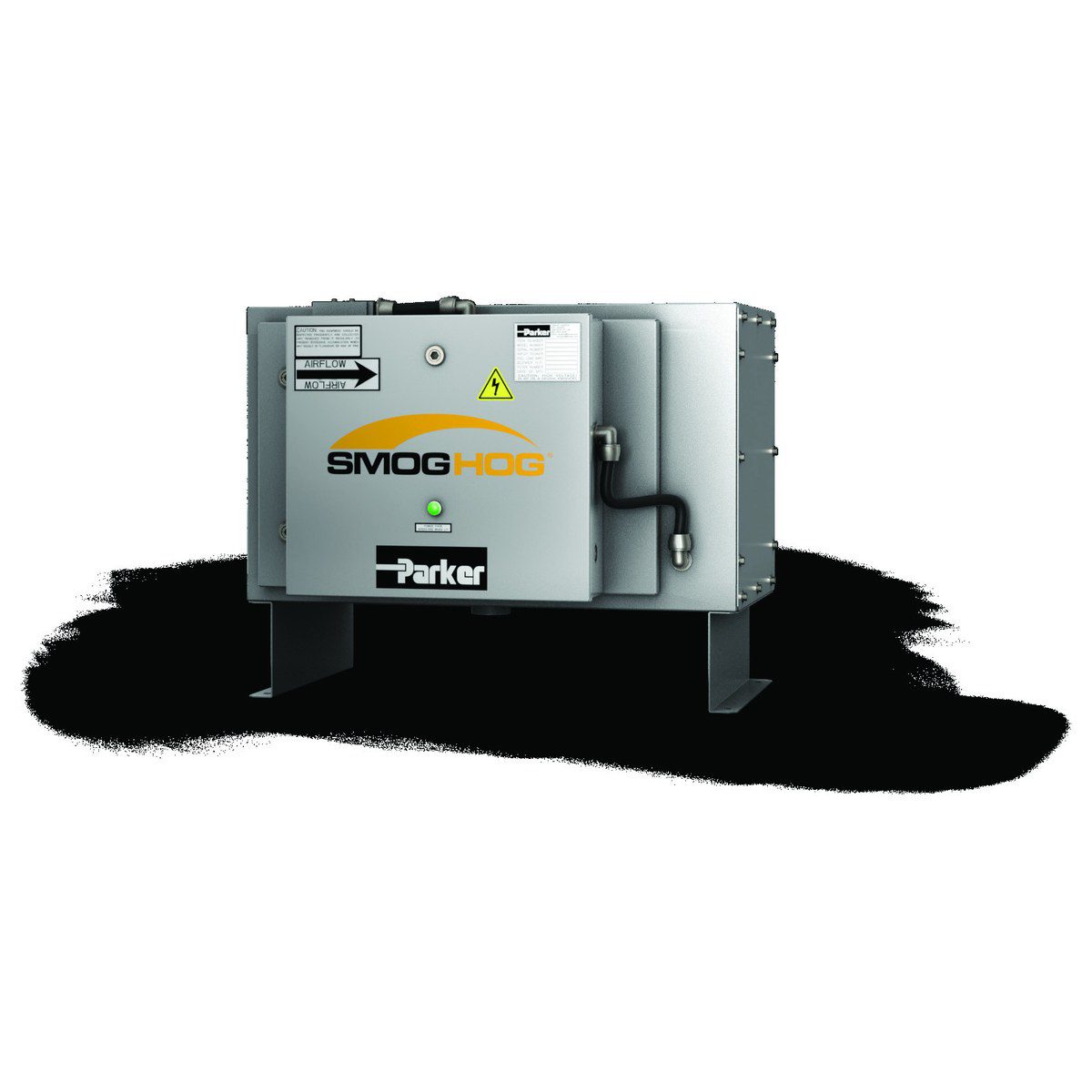
See the MSH from every side
You can see how it is built and how it sits on a site before you talk to anyone. Select a photo to see it full size.

The decision that matters
Single pass or double pass
This is the choice that changes the machine, not just the part number. A single pass sends the air through one collection cell. A double pass sends it through two in series, and SmogHog publishes overall removal above 97% on a double pass ESP against up to 95% of 0.3 micron particles on a single.
The honest version: double pass costs meaningfully more up front and doubles the cells you have to wash. It earns that back where the mist is heavy, where the air returns close to where people stand, or where you have already tried a single pass somewhere in the plant and it did not quite get there. On light intermittent machining it is more collector than the job needs.
| Choice | Options | What it changes |
|---|---|---|
| Size | 05 is 500 CFM, 11 is 1,100 CFM | How big an enclosure it can hold |
| Orientation | Horizontal or vertical | How it fits on the machine |
| Pass | Single or double | Removal, cost, and cells to wash |
| Airflow direction | Bottom to top, left to right, or right to left | Which side the inlet lands on |
| Power pack | Standard or high energy | Charging strength on heavier mist |
| Inlet collar | 6, 8, or 10 in., or none | What the flex duct clamps to |
MSH-11HSLS8 reads as 1,100 CFM, horizontal, single pass, left to right, standard power pack, 8 inch inlet collar. Collars are a horizontal option, and SmogHog lists sizes up to 12 inches. Vertical units draw bottom to top and take no collar.
Beyond the six, SmogHog offers machine mount kits, flexible duct and clamps, a vibration isolation kit, a drain loop assembly, a drain bottle, a power cord, and a remote power switch. On a machine an operator does not stand at all day, the remote switch is worth asking about.
Ownership
The cells wash, and that is the whole operating cost model
SmogHog calls a soak tank the most effective method, using hot water and an alkaline detergent with a buffering agent, at a water temperature of 140 to 170 degrees F and not exceeding 180. An automatic parts washer or a portable pressure washer both work.
Two cautions from SmogHog’s manual that are easy to get wrong: use nonflammable cleaners, never mix caustic and alkaline detergents, and let the cells and media dry fully before the unit goes back on. Starting a wet system causes a dead short.
SmogHog publishes no fixed cleaning interval, and the manual explains why plainly: the unit reflects the process under control, so the pattern varies. What SmogHog does recommend is a weekly visual inspection, which is the habit worth building rather than a number on a calendar.
Before you duct it
The blower is sized for the machine, not for a duct run
SmogHog’s manual states the MSH blower has limited static pressure capacity and to check with the factory for duct losses above 0.5 in. w.c. That is a short number, and it is the thing people find out after the fact.
A few feet of flex from the enclosure to the unit is what this machine is for. A run across the shop to a shared unit is a different family, and if that is where you are heading, the ceiling and machine mount SHN on the SmogHog line page is the one built to pull it.
SmogHog’s safety instructions are also worth stating outright: do not use in explosive atmospheres, and do not collect emissions which are explosive. Keep flammable materials and vapors away from the air cleaner.
Fit check
When the MSH is not right for you
Nobody is going to wash the cells
Say it out loud now rather than in eighteen months. An electrostatic collector that never gets cleaned is an expensive fan. If your PM program is already stretched, the media side of the line asks less of your crew, and we will price the honest option rather than the cheaper one.
You are ducting more than a few feet
The blower has limited static pressure capacity, and SmogHog says to check with the factory past 0.5 in. w.c. If the plan involves a real duct run or more than one machine on one collector, that is SHN or SGN territory, not MSH.
Your contaminant is dry dust
Grinding, sanding, sawing, and dry cutting are dust collector work, and a precipitator sized for aerosol is the wrong machine for it. See the DustHog line.
Your whole plant hazes over
If the problem is the building rather than the machines, machine mounts multiply into a bill nobody planned for. Ambient air cleaning is the comparison worth running first.
You need HEPA or carbon on the discharge
SmogHog publishes no HEPA or activated carbon afterfilter for the MSH. If your emissions target or your return air path requires one, that requirement points to a different family, and we would rather tell you that now than fit something that cannot get there.
Shop the MSH online
Order your SmogHog MSH
Every configuration on this list ships as shown, with replacement filters for the unit you already run. Not sure which size fits your machines? Call us and we will size it with you.
MSH questions
How much air does each model move?
The MSH-05 is rated 500 CFM and adjusts from 300, and the MSH-11 is rated 1,100 CFM and adjusts from 750 up to 1,500. Sizing starts from the enclosure openings on your machine rather than from the model list.
Does it need three phase?
No. The 05 runs on 115/1/60 and the 11 on 230/1/60. SmogHog publishes no three phase build of the MSH, which is part of why it lands so easily on a machine that already has power at it.
Single pass or double pass?
Double pass sends the air through two collection cells in series and SmogHog publishes overall removal above 97% for it, against up to 95% of 0.3 micron particles on a single pass. It costs more and doubles the cells you wash. Heavy mist, or air returning right where people stand, is what justifies it.
How often do the cells need washing?
SmogHog publishes no fixed interval, because the pattern follows your process. The manual recommends a weekly visual inspection, and the wash itself is a soak tank at 140 to 170 degrees F with an alkaline detergent, or a parts washer, or a pressure washer. Cells have to be fully dry before the unit runs again.
Can I duct it to the machine?
A short flex run from the enclosure, yes, with a 6, 8, or 10 inch inlet collar on a horizontal unit. A long run is a different question. SmogHog states the blower has limited static pressure capacity and to check with the factory above 0.5 in. w.c.
Does the air go back into the shop?
Yes. SmogHog builds it to recirculate the cleaned air into the plant, so you are not exhausting conditioned air through the roof or making it up somewhere else. Where the return path matters to a written emissions target, that is worth walking through together before the model gets picked.
Where does the coolant go?
Out a 1.5 inch NPT drain. SmogHog offers a drain loop assembly and a drain bottle, so how you catch it is a choice on the quote rather than something to sort out on the shop floor after it arrives.
Tell us the machine and who does your PMs
Those two answers pick the size, the pass count, and whether an electrostatic collector is the right family for you at all. You get back a configured part number and a firm number, including the answer where a media unit suits your crew better.
Sizing across several machines at once? Start on machining, tooling and CNC, or see the oil mist collector overview.