
The Southwest’s
Dust & Fume Authority
OSHA 1910.1000 • NFPA 660 compliant
Quick-Ship options • Full central systems in 8–10 weeks
0
CFM of Hazardous Air Captured Daily
0
Combustible Dust Fines for Our Clients
0
Average Emergency Response
0
NFPA 660 Ready Systems
What are realistic price ranges for dust collection systems?
Shop owners ask us this every week — here’s what shops in the Southwest are paying for turn-key systems (equipment + install) as of early 2026.
Smaller Shops
$8,000 – $50,000
1-6 portable extractors or downdraft tables. Plug in and go — covers main stations.
Small-Medium Shops
$60,000 – $125,000
Basic central cartridge collector with ducting to 4-8 points.
Medium Shops
$125,000 – $250,000
Central baghouse or cartridge collector with ducting. Does include some explosion protection.
Large/High-Volume Shops
$300,000 – $500,000+
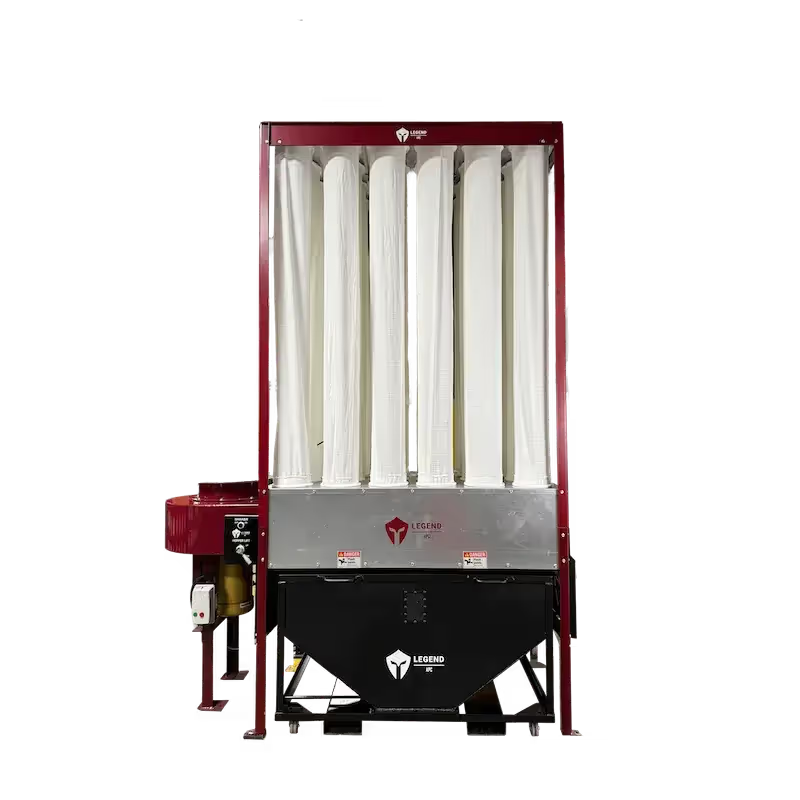
Large central cartridge collectors, extensive ductwork, full explosion safeguards — efficient for large/high-volume shops.
We always give fixed quotes after the free audit — exact number for your shop.


How do I make sure my dust collection system will pass an OSHA inspection?
That’s the question we hear most from shop owners across the Southwest — and it’s smart to think about it before an inspector shows up.
OSHA doesn’t have one single “dust collection” standard, but they enforce several that add up to a passing system. The goal is simple: keep dust levels low enough that workers aren’t breathing too much, and prevent buildup that could feed a fire or explosion.
📋 NFPA 660 Compliance Checklist →
🛡️ Explosion Protection Assessments →
Common OSHA Citations We See
- Housekeeping — dust layers thicker than 1/32 inch over too much area
- No explosion protection on combustible dust systems
- Workers exposed above PELs without controls
- No documentation of hazards or training
OSHA Inspection Prep Checklist
- Self-audit dust layers
- Test air quality
- Train team on procedures
- Document everything
- Fix gaps early
Explosion Protection Options
- Venting — releases pressure outside (cheapest)
- Flameless venting — safe indoors
- Chemical suppression — stops explosion early
- Isolation — prevents spread through ducts
Capture Velocity Basics (Transport in Ducts)
| Dust Type | Recommended Velocity (FPM) |
|---|---|
| Fine/light dust | 3500 |
| Sawdust | 4500 |
| Heavy (metal turnings) | 5000 |
| Weld smoke | 2500 |
Housekeeping Schedule Example
| Area | How Often | Method |
|---|---|---|
| Floors around machines | Daily | Housekeeping Port |
| Beams/ledges | Monthly | Extendable wand |
| Ducts inside | Yearly | Professional clean |
We’ve helped shops turn “likely citation” setups into passing ones with simple changes.
If any of this sounds like your shop, a free assessment shows exactly where you stand — no pressure, just facts.


What do I need to know about NFPA 660 for 2026?
Shop owners ask us this all the time — and now that NFPA 660 is enforceable as of January 1, 2026, it’s no longer a future problem. Here’s the plain-English explanation.
Key Changes in NFPA 660
- Consolidated standard — one code instead of many
- Dust Hazard Analysis (DHA) mandatory for combustible dust
- Clear deflagration protection rules based on Kst
- Specific housekeeping schedules
- Better isolation guidance
Common Dust Kst Values
| Dust Type | Kst Range | Severity |
|---|---|---|
| Wood | 100-200 | Weak |
| Aluminum | 400+ | Very Strong |
| Flour | 200-300 | Strong |
Protection Options
- Venting
- Flameless venting
- Chemical suppression
- Isolation
The good news: if your current system was designed to the old standards, you’re probably close. But many shops we visit still have gaps — and if your DHA turns up problems, we’ve got a step-by-step plan.
We help shops get ready by doing the DHA, updating protection if needed, and providing all the paperwork inspectors want to see. No guesswork.
Want to know where your shop stands? The free assessment includes a full NFPA 660 review — we’ll tell you exactly what you need (or don’t need).
How does the whole process work from assessment to installed system?
We get asked this every week — here’s exactly how it goes, step by step.
Step 1: Free On-Site Assessment
We come to your shop (no charge) with calibrated meters and take air samples. We measure capture velocities at each station, check dust accumulation, test for combustible dust if needed, and look at your layout. Takes 1-2 hours.
Step 2: Fixed-Price Proposal
Within 5 business days you get a complete proposal with drawings, equipment specs, installation timeline, and exact cost. No surprises.
Step 3: Design Approval & Permitting
We handle all permit drawings and fire marshal coordination. You just review and sign.
Step 4: Fabrication & Delivery
Equipment built to your specs. Quick-ship portables arrive in a week. Central systems ready in 8-10 weeks.
Step 5: Installation
Our crews handle rigging, structural supports, ductwork fabrication, and startup. Minimal downtime — we work weekends if needed.
Step 6: Commissioning & Testing
We test differential pressures, verify explosion venting, and run independent lab air samples. You get the passing report in hand.
Step 7: Training & Maintenance
We train your team on daily checks and pulse cleaning. Optional maintenance plans keep everything running strong.
The whole process is designed to fit around your production schedule. Most shops are fully operational during install.
Have questions about any step? That’s what the free assessment is for — we walk through it together.
5 Signs Your Dust Collector is Failing (Before OSHA Shows Up)
Your dust collector is dying. Here’s how to know before it’s a big problem:
1. Visible dust settling on equipment
Means filters are loaded and airflow’s dropping — dust isn’t getting captured like it should.
2. Team complaining more about the air
Headaches, coughing, stuffy shop — exposure is creeping up, and it can turn into a retention problem fast.
3. Pressure gauge reading higher than normal
Filters clogged, system working overtime — motor wears out quicker, efficiency tanks.
4. Dust building up inside the ductwork
Big fire or explosion risk — combustible dust loves hiding there.
5. System running all day but the shop still feels dusty
Often means it’s undersized for your current production or filters are shot.
We’ve seen shops ignore these until an inspection hits with a big fine. Catch ’em early, fix or upgrade, and you avoid the headache.
If any of these sound familiar, a quick check can tell you a lot.
What’s one you’ve noticed in your shop? Happy to help think through it.
Want to Dig Deeper?
Real answers about dust collection — costs, compliance, and what other companies won’t tell you.


Have questions about your shop’s dust collection?
Free site assessment — zero obligation — we’ll give you straight answers and exact numbers.