Safety & Compliance
Combustible dust compliance isn’t optional, and it isn’t something you handle after you fail an inspection. If your facility generates dust — wood, metal, food, pharmaceutical, plastics, certain composites — you’re inside the NFPA 660 framework whether you’ve read it or not. The question isn’t whether the standard applies to you. The question is whether your shop can prove it the day an inspector, an insurance underwriter, or your customer’s auditor walks through the door.
This is where most operators get caught: not from negligence, but from the gap between “we have a dust collector” and “we have a documented, engineered, tested system that meets NFPA 660.” Those are two very different things, and the enforcement record over the past decade is full of facilities that learned the difference the hard way.
The articles in this category cover the full combustible dust compliance picture — what NFPA 660 actually requires, when a dust hazard analysis (DHA) is mandatory, how to spec and protect your collector, what failed inspections look like, and what it costs to get compliant before something goes wrong.
What you’ll find in this category
- NFPA 660 Compliance Checklist — what an inspector will actually check, in plain language
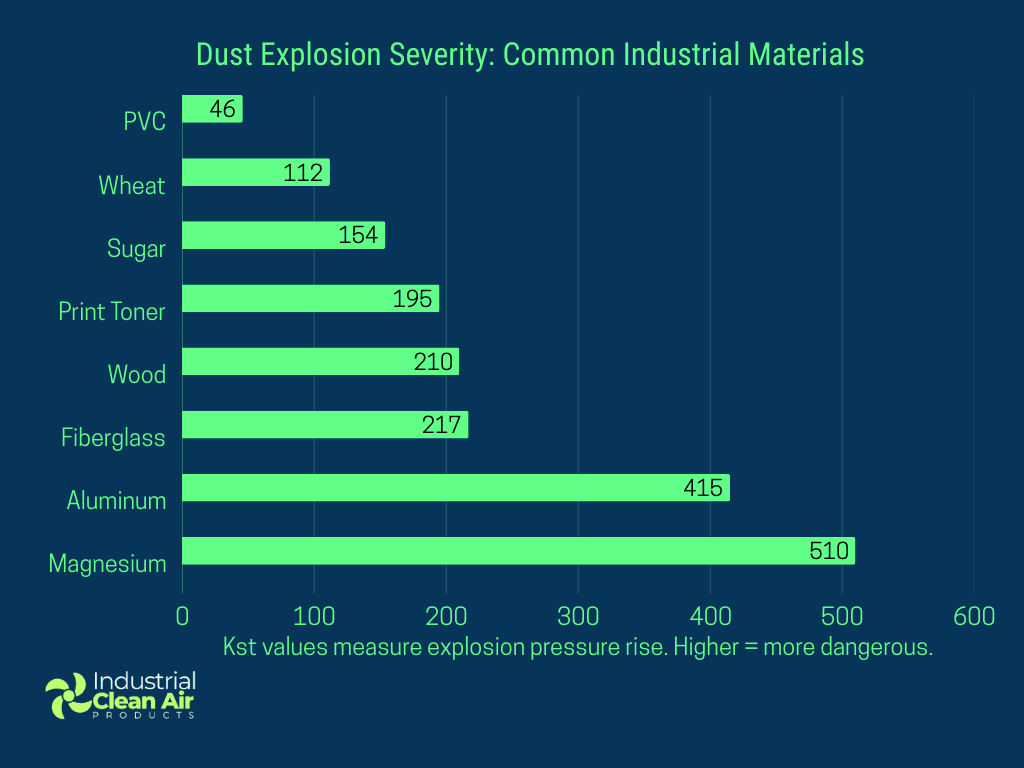
- KSt Values and Dust Explosion Severity — how to know if your dust is dangerous, with the actual numbers
- Dust Hazard Analysis Cost — what a DHA is, when you need one, what it should cost
- Failed DHA Fix-It Roadmap — recovery path if your last analysis came back with deficiencies
- Explosion Protection Assessments — venting, suppression, isolation, and when each is required
The questions we get most
Is NFPA 660 the same as NFPA 652?
No. NFPA 660 is the current, unified standard — effective January 1, 2026 — that consolidates the legacy combustible dust codes (652, 654, 664, 484, and 61) into a single document. If you were previously working from NFPA 652 (the umbrella) plus an industry-specific code, you now work from 660. The technical requirements largely carry over, but the structure and some specific provisions are updated. Anyone still citing 652 in 2026 is working from outdated documents.
How do you know if your dust is combustible?
Get a KSt test. KSt is the deflagration index — a measured value (bar·m/sec) of how violently a specific dust explodes when ignited. KSt under 200 is St-1 (mild — most wood and organic dusts). KSt 200–300 is St-2 (severe — aluminum, some plastics). KSt over 300 is St-3 (extreme — magnesium, some pharmaceutical powders). You can’t assume from material type. Two woodshops running different species, moisture content, and process equipment can have very different KSt values. Testing is the only way to know.
Does your facility need a dust hazard analysis?
If you handle any combustible dust, yes. NFPA 660 requires a DHA for every facility that processes, generates, or handles combustible particulate. The DHA documents what dusts are present, where they accumulate, what ignition sources exist, what protections are in place, and what gaps remain. It’s not a one-time event — it should be updated when processes change, equipment is added, or every five years at minimum.
What’s the cheapest way to get compliant?
The cheapest path to combustible dust compliance is the engineered one, done right the first time. Bandaid fixes — adding venting after the fact, retrofitting isolation onto undersized ductwork, swapping in a “bigger” collector without sizing the rest of the system — typically cost 50% more than building it correctly from the start. The real cost trap is unplanned compliance work after a failed inspection.
Your next step
Every system we install is backed by our pass-or-free compliance guarantee. Your system meets NFPA 660 and passes inspection, or we fix it at no charge. That’s not a marketing line — it’s how we underwrite our own engineering.
If you’re in Arizona, California, Nevada, New Mexico, or Utah and you’d like a free walkthrough of where your facility stands today, book a compliance assessment. On-site, no pressure, written report with specific findings. You’ll know exactly where you are inside the NFPA 660 framework and what — if anything — needs to change.