
Description
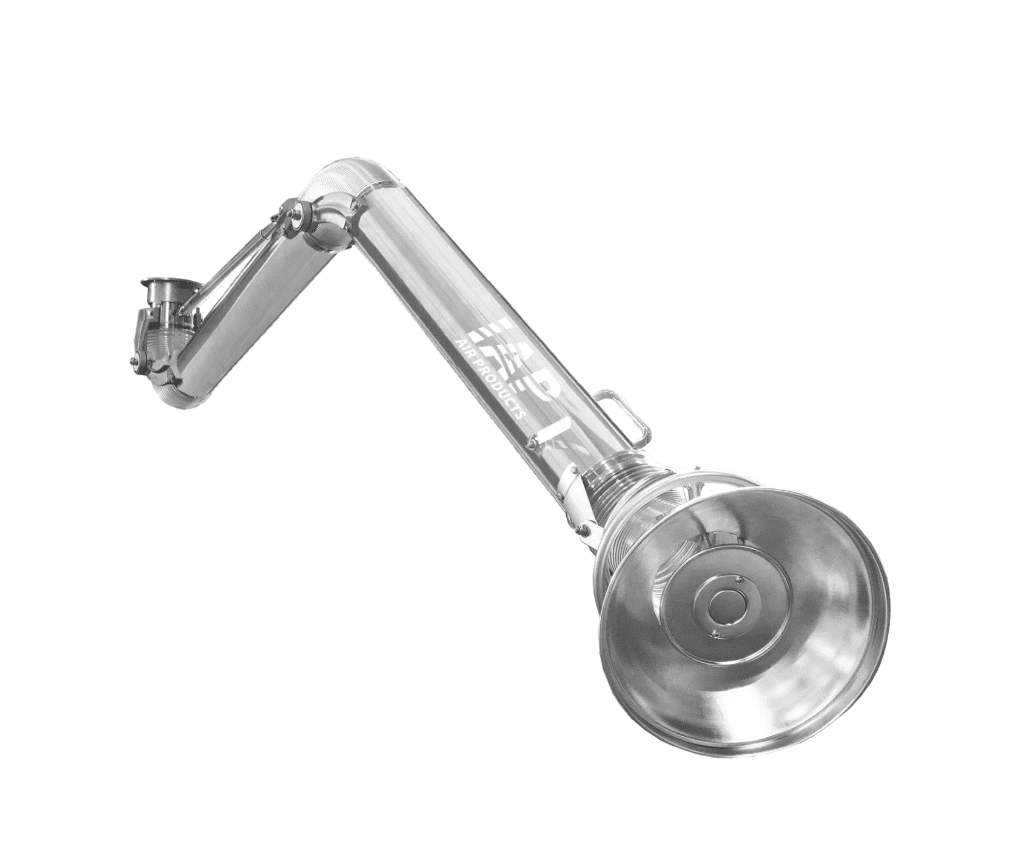
Stainless Steel Fume Arms
304 SS construction for pharmaceutical, food, aerospace, and cleanroom environments where carbon steel won’t pass.
Your facility runs under FDA cGMP, ISO cleanroom protocol, or pharmaceutical validation — and a galvanized arm with zinc plating just won’t survive the audit. Stainless steel fume arms exist for that reason. Smooth weld seams, no flaking coating, fully wipe-down compatible, and they hold up to the cleaning chemistries your facility actually uses.
We stock 304 SS fume arms in both hanging and standing configurations, in 3″, 4″, 6″, and 8″ diameters, with arm lengths from 3 feet to 14 feet. Pick your mount type, diameter, and length below — 15 configurations, all stocked, ready to ship in 3–5 business days from our Tennessee warehouse.
[VIDEO PLACEHOLDER: 80% Video — When SS fume arms are required and how to size them for cleanroom/pharma environments]
What Stainless Steel Fume Arms Are and How They’re Different
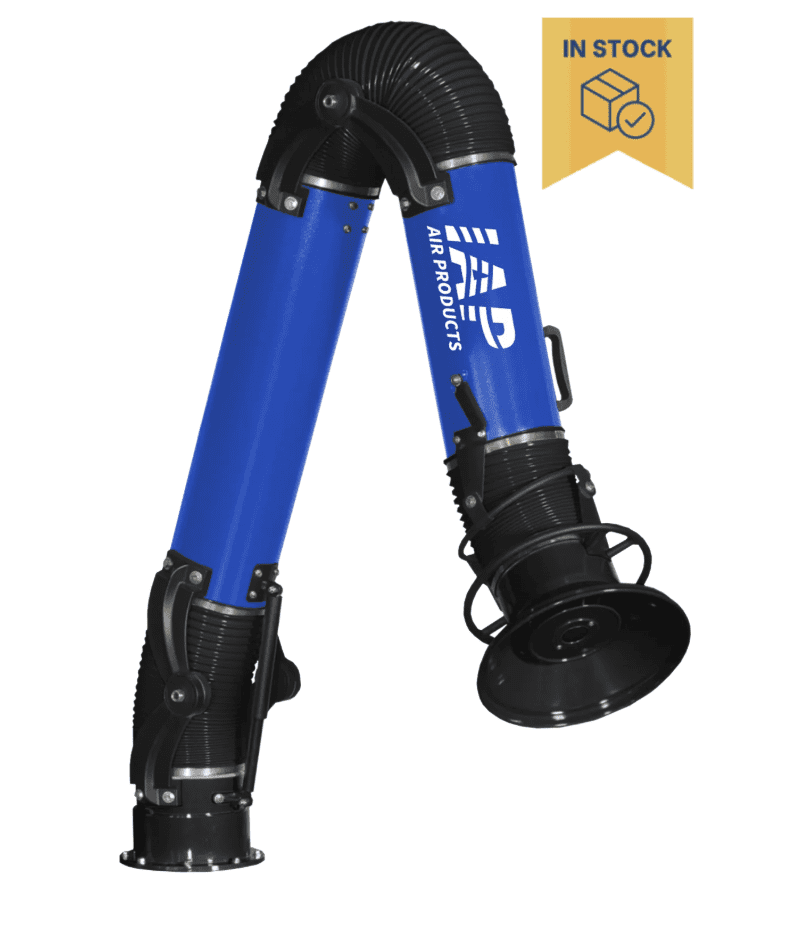
A 304 stainless steel fume arm has the same articulating geometry as a galvanized arm — outer tube, inner sleeves, friction joints at the elbow, articulating hood with built-in damper. The difference is the material. Every surface that contacts air, fume, or your wipe-down cleaning agent is 304 stainless steel. No zinc galvanizing to flake or dissolve. No paint to chip. No carbon steel substrate to rust if the coating gets scratched.
304 SS Construction
Tube, joints, hood frame, and bracket are all 304 stainless. Smooth weld seams that pass visual inspection in cGMP and cleanroom environments.
FDA-Compatible Hose
The flex hose is FDA-approved food-grade material — wipe-down compatible with the cleaning chemistries used in pharmaceutical and food facilities.
Two Mount Configurations
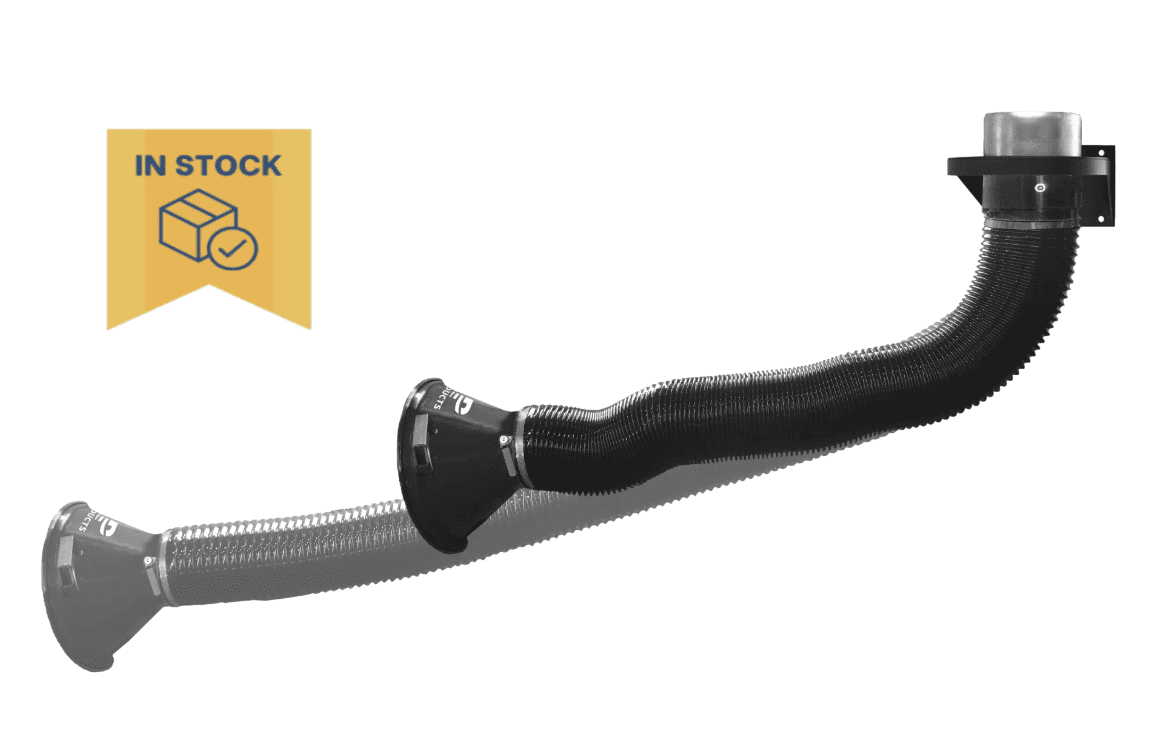
Hanging (ceiling joist or upper wall plate, 12 length options) or Standing (floor pedestal, 6 length options). Pick the geometry that fits your floor plan.
Built-In Damper
Aluminum capture hood with shut-off damper at the inlet. Close the arm at the hood when it’s idle to keep system airflow on the active stations.
Industries That Actually Need Stainless Steel Arms
Don’t pay for stainless if your shop doesn’t need it. Carbon steel arms are roughly 40% cheaper and they perform identically for welding, grinding, and general industrial fume capture. SS arms exist specifically for environments where the material itself matters:
If your operation falls in one of these — or if your QA department has flagged the existing galvanized arms during audit — stainless is the right answer. See our pharmaceutical industry page or food & supplement page for industry-specific compliance context.
Sizing Guidance — Match Diameter to CFM, Length to Reach
Two decisions: what diameter pulls enough air for your process, and what length reaches your work area from the mount point.
| Diameter | CFM | Hood | Best For | Lengths Available |
|---|---|---|---|---|
| 3″ | 350 | 10″ | Light handling, soldering, small powder tasks | 3′, 5′ (both mounts) |
| 4″ | 600 | 10″ | Standard powder handling, compounding, blending | 5′ (both), 8′ (hanging only) |
| 6″ | 1,050 | 13″ | Heavy powder transfer, large bagging, API processing | 7′ (both), 10′, 14′ (hanging only) |
| 8″ | 1,400 | 13″ | Largest fume volumes, specialty applications | 7′ (both), 10′, 14′ (hanging only) |
Mount type — hanging vs. standing
- Hanging arms mount to a ceiling joist or upper wall plate and drop down to the work. Use them when ceiling height is your primary mounting surface, or when floor space at the work zone is at a premium. Hanging gets you 12 length options up to 14 feet.
- Standing arms mount to a floor pedestal at bench height and articulate over to the work. Use them when ceiling mounting isn’t practical or when the work area is open. Standing comes in 6 length options up to 7 feet.
If you’re mid-decision, book a 15-minute call and we’ll size it against your actual collector and process layout.
FDA, OSHA, and NFPA 660 Compliance Context
Stainless arms exist primarily because of cleanability and contamination requirements — not because they capture fume better than carbon steel (they don’t, the airflow is identical). Here’s where the material matters:
FDA cGMP — 21 CFR Part 211
If your facility runs under cGMP for pharmaceutical, food supplement, or biologics manufacturing, your equipment surfaces in product-contact and adjacent zones need to be cleanable, non-shedding, and non-reactive. Galvanized steel fails both shedding and corrosion-resistance criteria during audits. 304 SS passes both. The FDA-approved hose pairs with the SS arm tube to give you a fully validated product-zone airpath.
ISO 14644 Cleanroom Standards
Class 1000 (ISO 6) through Class 100,000 (ISO 8) cleanroom environments require equipment that doesn’t shed particles. SS arms with smooth-finish welds and no flaking coatings hold up under cleanroom particle counts. Carbon steel arms typically don’t qualify above Class 100,000.
OSHA welding fume rules still apply
- OSHA 29 CFR 1910.1026 — Hexavalent chromium PEL of 5 µg/m³. SS welding generates Cr(VI) — the arm captures it.
- OSHA 29 CFR 1910.1000 Table Z-1 — PELs for nickel, manganese, iron oxide. Stainless welding fume is loaded with all three.
- ACGIH — 100 ft/min minimum capture velocity at the source, same as carbon steel arms.
NFPA 660 — combustible dust
NFPA 660 (effective January 1, 2026) is the unified combustible dust standard. It applies to your collector and ductwork system when you’re capturing combustible material — including pharmaceutical powders like lactose, MCC, and many APIs that are KSt-rated combustible. The arm is the entry point of that system. If your dust is combustible, you need a DHA and your collector and ductwork need explosion protection. The SS arm itself doesn’t change that calculus, but it’s the right material choice for the powder side. Pull the NFPA 660 checklist to see where you stand.
When Stainless Steel Arms Are NOT Right for You
SS arms cost roughly 1.7× to 2.3× what the equivalent carbon steel arm costs. Here’s when you should buy carbon steel instead:
- You’re doing welding, grinding, or general fab. Carbon steel arms handle weld fume, slag, sparks, and grinding dust as well as SS — for $1,200–$2,000 less per arm. Buy galvanized arms here.
- Your QA team hasn’t flagged it. If your existing arms are passing audit, you probably don’t need to upgrade. SS is a problem-solver for facilities where galvanized has been rejected — not a default upgrade.
- You need explosion-rated equipment. SS isn’t ATEX-rated by itself. If your dust is combustible and you need spark-proof, anti-static construction, the arm material is one piece of the puzzle — you need full system explosion protection. Talk to us about explosion protection before buying any arm.
- You’re handling oil mist, coolant aerosol, or wet machining fluids. Source capture arms (SS or otherwise) are dry-fume hardware. For machining mist, look at oil mist collectors.
- Your reach exceeds 14 feet. The longest SS arm is a 14-foot hanging arm. If you need 15+ feet, you want a boom-mounted system or an in-duct extension — not a standalone arm.
- You only need one or two arms and budget is tight. If carbon steel arms would technically pass and the audit risk is low, the upgrade may not be worth $4,000+ per station. Have us walk through the cost-benefit before committing.
If any of those apply, we’d rather steer you to the right product. Call 602-456-9661 or book a 15-minute sizing call.
Cost Range — What You’ll Actually Pay
Stainless steel fume arms run $2,959 to $6,609 depending on mount type, diameter, and length. That’s the arm itself, ready to mount, with bracket and hardware. Free freight to AZ, CA, NV, NM, UT.
| Configuration | Diameter | Length | Price |
|---|---|---|---|
| Standing (entry) | 3″ | 3′ | $2,959 |
| Hanging (entry) | 3″ | 3′ | $3,059 |
| Standing (mid) | 6″ | 7′ | $4,669 |
| Hanging (mid) | 6″ | 10′ | $4,949 |
| Standing (top) | 8″ | 7′ | $5,759 |
| Hanging (top) | 8″ | 14′ | $6,609 |
For full-system pricing — collector, ductwork, multiple SS arms, explosion protection, installation — walk through our 2026 dust collection system cost guide. A typical pharmaceutical or food-grade installation with cartridge collector, four SS arms, and FDA-compliant ductwork lands between $45,000 and $85,000 installed depending on explosion protection scope.
Recommended Add-Ons
Two accessories pair with stainless arms. Add to cart separately if either fits your operation.
Note: SS arms are typically used in non-spark environments (powder handling, cleanroom, compounding), so most customers don’t need the spark protector. Add it only if your specific process generates sparks.
Frequently Asked Questions
Why does the same diameter cost more in stainless than galvanized?
Material cost. 304 stainless steel raw stock runs roughly 4× the price of galvanized carbon steel per pound, and the welding and fabrication labor is more involved (TIG-welded smooth seams instead of MIG). Plus the FDA-compatible hose adds another ~$80–$120 per arm depending on length. The finished arm typically costs 1.7× to 2.3× the carbon steel equivalent.
Will SS arms work with my existing carbon steel ductwork?
Mechanically yes — the arm bolts to a 3″, 4″, 6″, or 8″ round inlet just like a galvanized arm. But if your facility is under cGMP or cleanroom validation, you’ll typically want SS ductwork too, because mixed materials raise audit questions about contamination paths. We can spec a full SS system. See our industrial ductwork page.
Can I install stainless arms myself?
The mechanical install is identical to galvanized — bolt the bracket to a stud or mounting plate, connect the duct, level it. 60–90 minutes per arm. The validation and qualification documentation in a regulated facility takes longer than the install. If you need IQ/OQ documentation support for FDA compliance, we provide that with installation services.
What’s the difference between hanging and standing in this catalog?
Hanging arms drop from a ceiling joist or upper wall plate and articulate over and down to the work — you mount above and reach down. Standing arms mount to a floor pedestal at bench height and articulate over to the work — you mount at floor level and reach up and over. Hanging suits high-bay shops or cleanrooms with ceiling mounting infrastructure. Standing suits open floor layouts where ceiling mounting isn’t practical. Hanging has 12 length options up to 14 feet; standing has 6 options up to 7 feet.
Do you provide IQ/OQ documentation for FDA-regulated facilities?
Yes — for installations done by us. The documentation package includes installation qualification (IQ) verification, operational qualification (OQ) airflow testing, material certifications for the SS components, and the FDA hose data sheet. If you’re self-installing, we can provide the material certs and hose documentation; the IQ/OQ has to be done at your facility by you or your validation contractor.
What CFM does my collector need to handle these arms?
Match arm diameter to collector capacity. A 3″ arm needs ~350 CFM available. 4″ needs ~600. 6″ needs ~1,050. 8″ needs ~1,400. If you’re running multiple arms off one collector, total the CFM and add 15% headroom for ductwork losses. Send us your collector model and we’ll verify the fan curve.
Are these ATEX or explosion-rated?
The arm itself is 304 SS — it doesn’t generate ignition sources on its own. But “explosion-rated” is a system-level designation, not an arm-level one. If you’re capturing combustible dust, the system needs explosion protection: spark detection, isolation valves, suppression or venting on the collector, grounding throughout. The arm is one piece of that system. Get an explosion protection assessment before sizing the arm if you have combustible dust.
How long does shipping take?
3–5 business days to anywhere in AZ, CA, NV, NM, or UT. Free freight on stainless arm orders. Stocked in our Tennessee warehouse — we don’t wait on the manufacturer.
What’s the warranty?
Two-year manufacturer warranty on the arm tube, articulating joints, and damper, covering defects in materials and workmanship. We keep replacement parts in stock for the entire IAP arm line — if something fails outside warranty, we can usually quote and ship the part the same day.
Pick Your Configuration Below
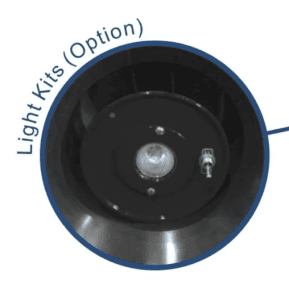
Choose your mount type (hanging or standing), your diameter (3″–8″), and your length (3’–14′). The price updates as you select. Add the LED light kit or spark protector separately as add-ons if your application calls for them.
Related Products & Guides
Get Your SS Arm Sized Right
Book 15 minutes with us and walk away knowing exactly which mount type, diameter, length, and accessories your facility needs.
Reviews
There are no reviews yet.